

Intel is pushing the boundaries of server processor density with its next-generation Diamond Rapids architecture, a move that redefines the ceiling for single-chip core counts in data centers. This announcement matters because it signals a shift toward extreme parallelism for cloud providers who need to maximize hardware utilization per rack unit. We are looking at a silicon design that prioritizes raw throughput over traditional single-threaded latency, catering specifically to infrastructure-as-a-service workloads. The platform targets enterprises that require massive computational density without scaling their physical footprint.
Next-gen server chip uses 18A process and Foveros 3D packaging
The Diamond Rapids processor, part of the Xeon 7 family, represents Intel's first commercial product built on the enhanced Intel 18A-P process node. This manufacturing technology enables the integration of up to 256 Panther Cove-X performance cores on a single die. Intel utilizes Foveros Direct 3D packaging to stack these components, creating a highly integrated architecture that departs from previous multi-chip designs. The chip also employs UCIe-S interconnect technology to manage communication between its internal tiles, ensuring efficient data flow across the massive core count.
Specifications
- Max Cores: 256 P-cores
- Last Level Cache: 1.28GB
- Memory Channels: 16-channel DDR5
- Memory Speed: 12800 MT/s
- PCIe Lanes: 128 PCIe 6.0
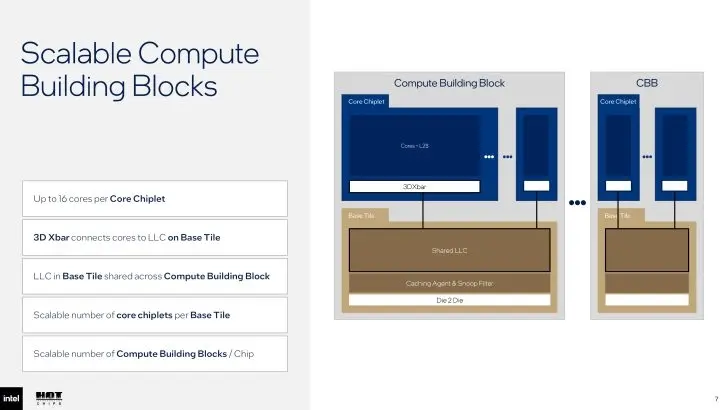
Memory bandwidth and expansion capabilities see significant upgrades in this generation to support the high core count. The processor supports 16-channel DDR5 memory running at speeds of 12800 MT/s, which Intel claims is double the speed of the previous Xeon 6 generation. This memory architecture is managed by a new Fabric Hub that separates memory controllers from the compute tiles using Flexbus I/O fabric. Storage and peripheral connectivity are handled by 128 PCIe 6.0 lanes, providing ample bandwidth for high-speed NVMe drives and AI accelerators.
Intel has integrated advanced instruction sets including AVX-10.2, APX, and enhanced AMX to optimize performance for modern computational tasks. The architecture includes CXL 3.0 support to facilitate memory expansion and pooling, which is critical for AI and database workloads. While hyper-threading is absent in this specific generation, Intel notes it will return in the subsequent Coral Rapids release. The design includes a 1.28GB last-level cache to reduce latency for frequently accessed data across the 256 cores.
Diamond Rapids is scheduled to launch in 2027, giving system integrators time to develop motherboards and cooling solutions for this high-density chip. We looked at Intel Xeon 6700P Gets 8000MT/s DDR5 in our earlier Intel coverage to understand the trajectory of memory speed improvements. This new platform offers a concrete path for cloud providers to increase compute density, though it requires significant infrastructure adjustments. The 2027 release date marks the beginning of the 18A era for high-performance computing.
Discussion
0 comments
Log in to join the thread with a thoughtful take, question, or correction.