
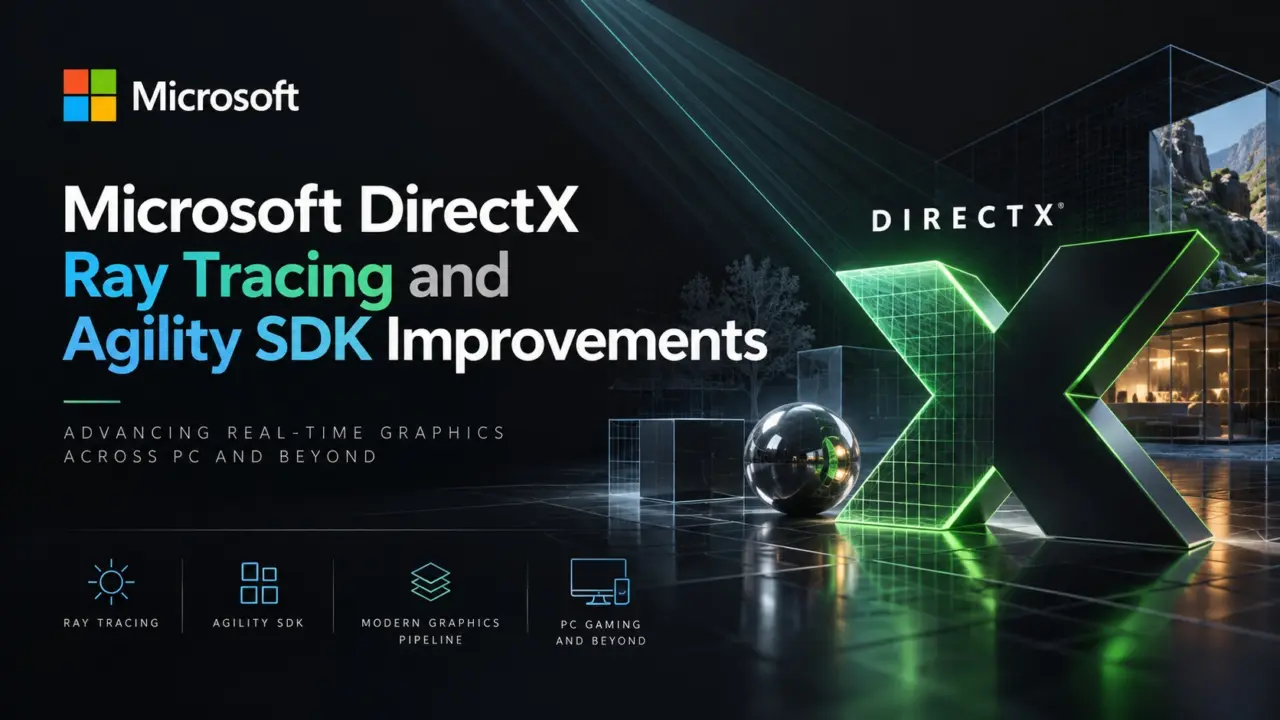
Microsoft has just rolled out new versions of their DirectX 12 Agility SDK. This is a massive change to how dynamic scenes approach raytracing. This is significant as it helps drastically improve the memory and compute requirements for these scenes, two things which often act as a bottleneck in real-time rendering.

New SDK version reduces ray tracing memory by 90% and build times by 250x
This means you can create more complex geometry with much lower overhead and should see smoother frame-rates in supported games as a result. Existing games may not have patches out just yet, but you could very likely benefit from improved performance in existing games if you have modern hardware.
Specifically, there are two versions here. One is retail 1.620 and the other is the preview version 1.722. The 1.722 version features Clustered Geometry and Partitioned Top Level Acceleration Structures (PTLAS) replacing previous versions of acceleration.
This allows for much better processing of the GPU when dealing with raytracing data. It breaks down the data on the scene into smaller and more digestible pieces. The 1.620 (retail) version helps improve Advanced Shader Delivery for wider support for graphics programs for various vendors.
From their own development sample, Microsoft showcases some pretty insane efficiency improvements with the Clustered Geometry. For starters, this resulted in a 96.4% reduction of memory for animated acceleration structures. It went from 6794 MiB down to 244 MiB.
This also resulted in an 89.7% reduction in overall memory usage. It was previously 7519 MiB, but it is now only 774 MiB. Acceleration structure build times also went from 788ms to 3.11ms.
The time it took the GPU to perform raytracing improved by about 7.8x. It was 72.6ms previously but it is now down to 9.27ms.
The preview version of the SDK will work with NVIDIA GeForce RTX cards, AMD Radeon RX 9000 series, and Intel Arc B series. It will also work with supported Intel Core Ultra integrated graphics. Advanced Shader Delivery is now widely available on Windows 11 across AMD, Intel, NVIDIA, and Qualcomm GPUs.
Partial Graphics Programs (new optimization) is currently limited to AMD Radeon RX 7000/RX 9000 series only. Shader Model 6.10 remains a preview feature. We’re looking at early December for the retail release.
Keep in mind, this is on their specific development sample with their specific setup. Your real-world results in game will vary depending on workload, implementation, and GPU architecture. Be aware there will be a slow trickle of games adopting these new features within their SDK. It is a better starting point for continued improvements in raytracing for any supported hardware going forward.
Comments (0)