
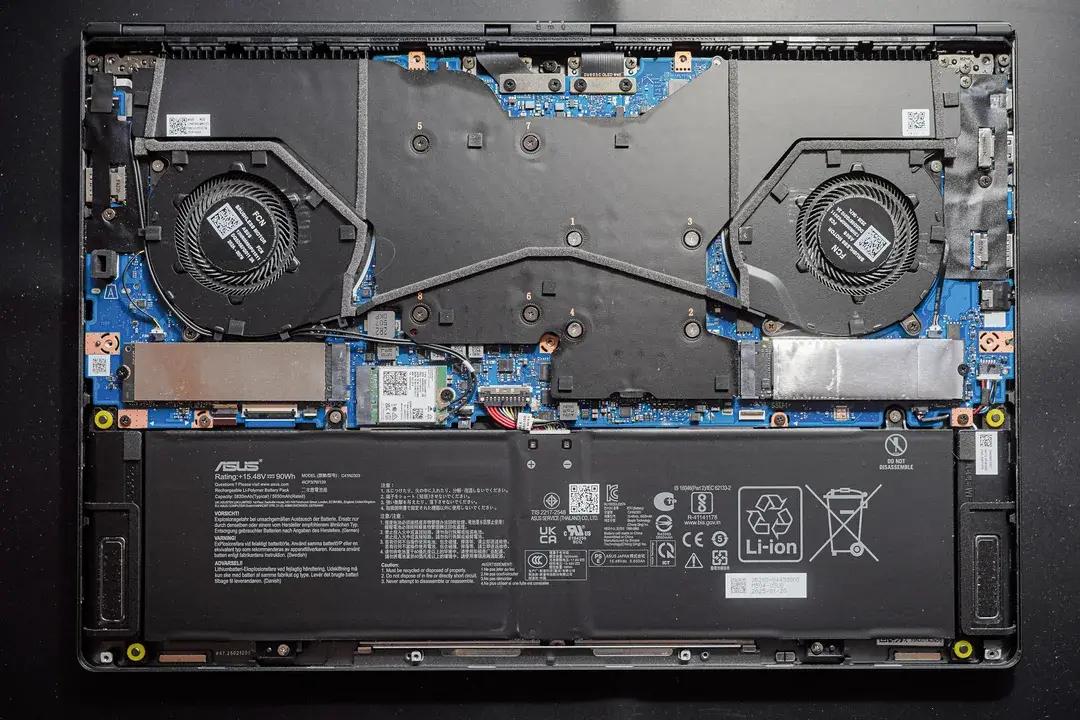
Asus Rog Strix Scar 16 (2025) CPU becomes significantly faster with a simple cooling tweak. It was found by a Redditor that by changing the stock thermal interface materials the user can reach an increased sustainable power that was previously capped. The relevance of this change is the fact that there is a thermal limitation within the laptop design. This limitation is something users can adjust on their own without needing to purchase new components.
User mod replaces stock thermal materials to unlock higher sustained power
The tweak enables the Intel Core Ultra 9 285H CPU to use higher power limits which directly increases multi-core performance. The specific laptop being referred to has a NVIDIA GeForce RTX 5070 Ti Mobile GPU and an Intel Core Ultra 9 285H CPU.
The tweak has been carried out on the user's particular laptop to fix the thermal throttling problem which kept the CPU locked to a sustainable power of 35W only. The stock cooling configuration had liquid metal on the CPU, regular thermal pads on the GPU, and putty on VRAM and VRM. The stock thermal interface materials were changed to aftermarket ones to enhance the heat transfer efficiency.
Specifically, the stock liquid metal on the CPU was replaced with the Thermal Grizzly KryoSheet graphene pads, stock thermal pads on GPU with PTM phase change thermal pads, and VRAM and VRM with the Thermal Grizzly Putty Pro. With these changes the sustainable power limit for the CPU has gone up from 35W to 85W. Also, peak CPU temps dropped from 105 degrees Celsius to under 100 degrees Celsius, with an improved core temperature consistency.
After the tweak the Cinebench 26 multi-core scores have gone up by 35% which equates to around 1200 more points. The user mentions that this boost is a result of CPU not throttling anymore because of the heat. This shows that the stock thermal design was holding back the full potential of the CPU. For users who want to get the most out of their laptop's CPU, this tweak might be interesting to them.
It's important to note that the stated increase of 35% in performance is not certain to occur for everyone or every model. It varies depending on the starting condition of the cooling system, application quality and the specific testing environment. The article mentions that this tweak doesn't mean all gaming laptops suffer from the same thermal problem. So users should keep these factors in mind if they are thinking of making similar tweaks to their own laptops.



Discussion
0 comments
Log in to join the thread with a thoughtful take, question, or correction.