
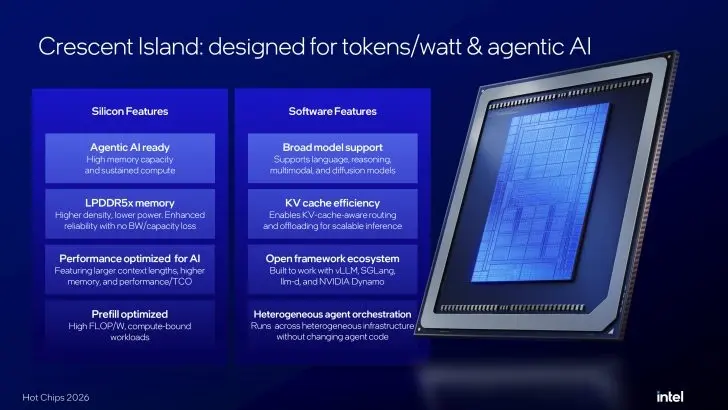
Intel has officially launched the GPU D270, marking its first commercial datacenter GPU release since the Ponte Vecchio era. This arrival matters because it targets the growing demand for AI inference hardware that fits into standard server racks without requiring exotic cooling solutions. The card delivers 1.3 PFLOPS of FP8 compute power while maintaining a manageable 350W thermal design power. Buyers focused on scaling inference workloads can now evaluate a pure air-cooled option that simplifies datacenter deployment.
Intel's new inference accelerator targets standard air-cooled datacenter racks
The GPU D270 is built on Intel's Xe3P architecture and serves as the commercial realization of the previously codenamed Crescent Island accelerator. Intel officially named the GPU D series and announced final performance specifications on October 12. The design integrates 32 Xe3P cores and 256 XMX matrix engines to handle heavy matrix operations. This configuration positions the card as a specialized tool for running large language models at scale.
Specifications
- Memory: 480GB LPDDR5X
- Compute Performance: 1.3 PFLOPS FP8
- TDP: 350W
- Architecture: Xe3P
- Memory Bandwidth: 1.5TB/s
Memory capacity stands at the top of the card's specifications with up to 480GB of LPDDR5X installed. The memory runs at speeds of approximately 9375 MT/s to support a flagship bandwidth of 1.5TB/s. Intel states that a single card can host models with 300 billion parameters. This large memory footprint allows the hardware to keep substantial model weights on-chip for faster inference.
Intel claims that an eight-card cluster can run models with trillion-parameter scales. The software stack supports vLLM and PyTorch and is compatible with Arc Pro codebases. The card also achieves zero-day support for the Meta Muse Glimmer 30B open-weight model. These software integrations ensure the hardware can run modern open-source AI frameworks out of the box.
Official pricing and mass production dates remain undisclosed at this time. Independent third-party performance data is also not yet available for verification. Intel has not released specific details regarding when customers can place orders or receive units. The company is currently focusing on sharing the technical capabilities of the new accelerator.


Discussion
0 comments
Log in to join the thread with a thoughtful take, question, or correction.