
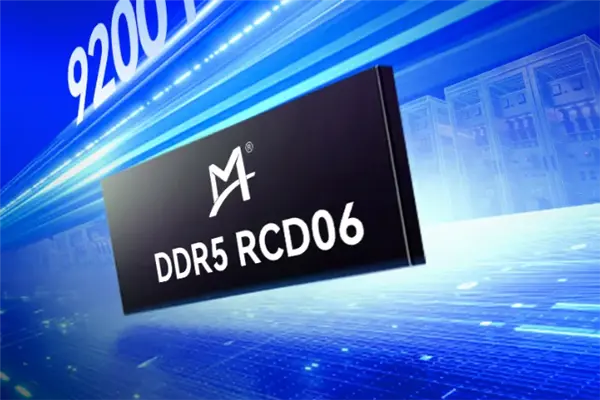
Montech Technology has successfully sampled its sixth-generation DDR5 RCD chip, designated as the RCD06. Montech Technology has advanced its DDR5 RCD chip design with the successful sampling of the RCD06 model, which supports data transfer rates up to 9200 MT/s.
Montech Technology samples sixth-generation register clock driver chip with dual-channel architecture and enhanced signal integrity features.
The new component targets the register clock driver role within DDR5 architecture. The new chip features a dual-channel independent architecture that enhances signal integrity through Continuous Time Linear Equalization (CTLE) and a Low Jitter Phase-Locked Loop (PLL).
Montech reports that the RCD06 supports data transfer rates up to 9200 MT/s. This figure represents a 15 percent performance increase compared to the previous generation chip. The design uses a dual-channel independent architecture that shares clock logic while maintaining separate operation for odd parity checking.
The chip integrates Continuous Time Linear Equalization and a Low Jitter Phase-Locked Loop circuit. These features aim to enhance signal integrity and deliver precise clock distribution across memory modules.
Montech Technology has successfully sampled its sixth-generation DDR5 RCD chip, designated as the RCD06. Montech Technology has advanced its DDR5 RCD chip design with the successful sampling of the RCD06 model, which supports data transfer rates up to 9200 MT/s.
The new component targets the register clock driver role within DDR5 architecture. The new chip features a dual-channel independent architecture that enhances signal integrity through Continuous Time Linear Equalization (CTLE) and a Low Jitter Phase-Locked Loop (PLL).
Montech reports that theRCD06 supports data transfer rates up to 9200 MT/s. This figure represents a 15 percent performance increase compared to the previous generation chip. The design uses a dual-channel independent architecture that shares clock logic while maintaining separate operation for odd parity checking.
The chip integrates Continuous Time Linear Equalization and a Low Jitter Phase-Locked Loop circuit. These features aim to enhance signal integrity and deliver precise clock distribution across memory modules.
Discussion
0 comments
Log in to join the thread with a thoughtful take, question, or correction.