

Intel introduced two new processors designed to make local artificial intelligence tasks faster and more accessible for everyday users. The Core Ultra Series 3 lineup shifts the focus from raw compute power to efficient hybrid AI deployment. This change matters because it allows standard laptops to run large language models without relying entirely on cloud services. Buyers who want to reduce subscription costs or work offline will find these chips relevant.
New processors enable local LLM inference and reduce cloud dependency
The new lineup includes the Core Ultra 7 358H and the Core Ultra 5 325. Both chips launch on July 7, 2024, as part of Intel's push to popularize Agent PCs. The higher-end 358H targets power users with a 16-core, 16-thread configuration. The entry-level 325 offers an 8-core, 8-thread design for mainstream devices. Both processors integrate Intel's fifth-generation NPU to handle AI workloads efficiently.
Spec comparison
| Spec | Core Ultra 7 358H | Core Ultra 5 325 |
|---|---|---|
| CPU Cores | 16 cores, 16 threads | 8 cores, 8 threads |
| Max Boost Clock | 4.8 GHz | 4.5 GHz |
| GPU Config | Arc B390, 12 Xe3 cores | Intel Graphics, 4 Xe3 cores |
| Platform AI | 180 TOPS | ~100 TOPS |
| NPU Performance | 50 TOPS INT8 | 50 TOPS INT8 |
The Core Ultra 7 358H features an Intel Arc B390 GPU with 12 Xe3 cores running at 2500 MHz. It delivers a total platform AI performance of 180 TOPS. The Core Ultra 5 325 uses a simpler Intel Graphics GPU with 4 Xe3 cores at 2450 MHz. It provides approximately 100 TOPS of combined AI computing power. Both chips share a 50 TOPS INT8 NPU for dedicated neural network tasks.
Intel demonstrated significant memory optimization through a collaboration with Longsys on an AI SSD solution. This technology uses HLCache to offload mixture-of-experts models, reducing memory usage from over 20GB to under 12GB. The system can save up to 30% of memory, allowing 64GB laptops to run 122B parameter models. In testing, the 358H achieved 43 tokens per second for local LLM inference. The 325 platform reached over 70% of the 358H's speed for similar tasks.
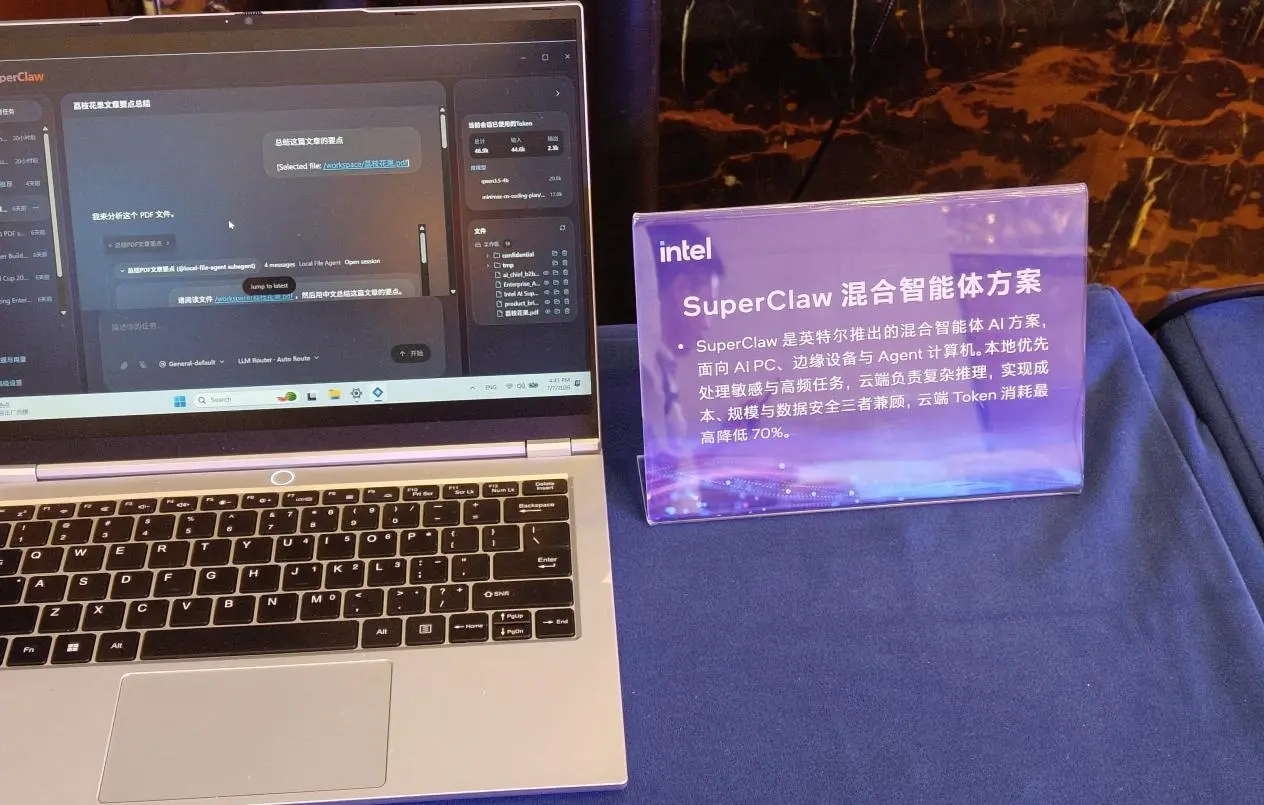
Intel outlined a strategy for hybrid AI that balances local processing with cloud resources. The company calls this the 'Smile Curve,' where sensitive or frequent tasks stay on the device while complex inference moves to the cloud. A model routing mechanism called SuperClaw reduces cloud token consumption by up to 70%. We touched on Intel Cuts European Fabs, Accelerates Arizona in our earlier Intel coverage, but this launch focuses specifically on the software and hardware integration for AI agents. Over 20 partner solutions demonstrated these capabilities at the event.

Discussion
0 comments
Log in to join the thread with a thoughtful take, question, or correction.