
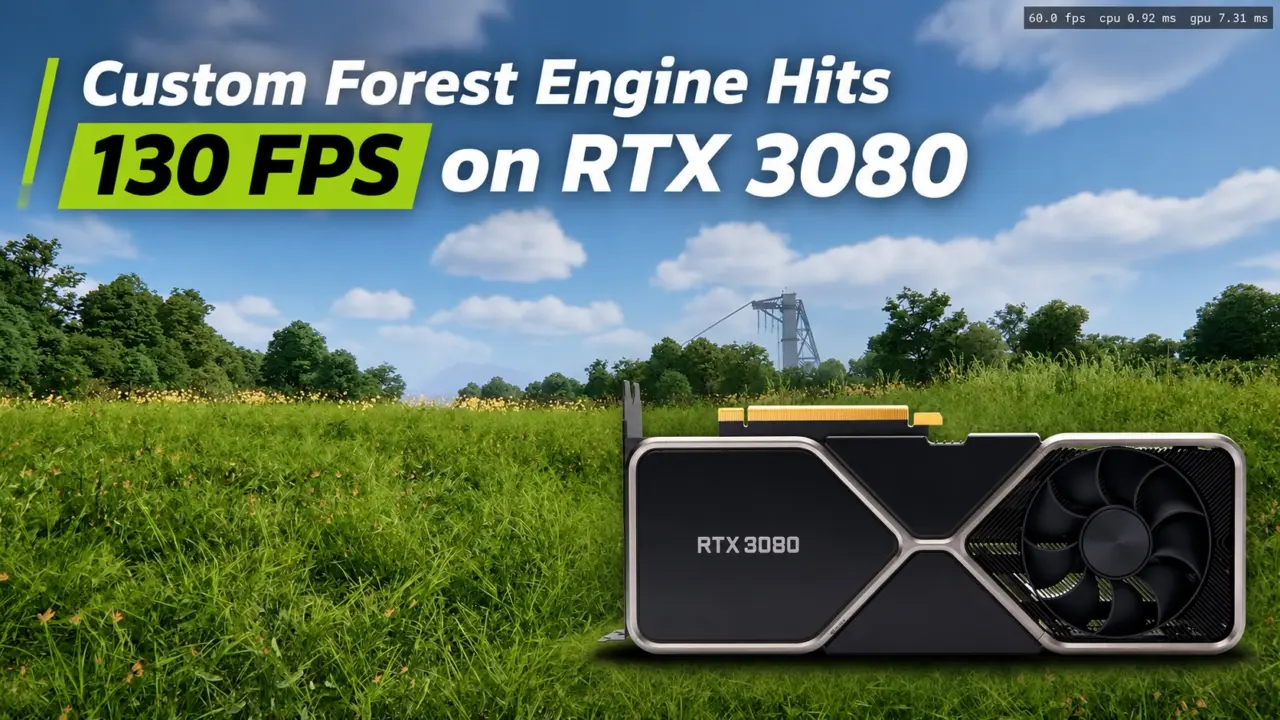
A developer by the name of Toni Macaroni shared a tech demo of a custom forest rendering engine he's built running at 130 FPS on a NVIDIA GeForce RTX 3080. It's important because it shows how you can get good frame rates using modern rendering techniques without breaking the bank with hardware ray tracing. For PC gamers who want to learn more about optimization and engine architecture this benchmark is a good one to look at when thinking about your hardware.
Developer showcases 130 FPS average at 1440p using voxel global illumination
The demo is of a scene with about 1M instances and 4M triangles. Toni Macaroni spent 7 months developing the engine that allows for such geometric density. It's a proof of concept for efficiently rendering large scale environments in real time for applications.
- Average FPS: 130 FPS
- Resolution: 1440p
- GPU: NVIDIA GeForce RTX 3080
- Aerial View FPS: Up to 200 FPS
- Dense Forest FPS: Around 80 FPS
The engine has the performance goals it wants to hit by using clustered levels of detail (CLODs) and a sort of Nanite virtual geometry. It's also using voxels for distant vegetation to ease the workload. This is so you can get fluid gameplay even in heavily forested areas where it could be difficult with traditional techniques.
The lighting in the demo uses screen space methods with a voxel based global illumination. It's similar to the Sparse Voxel Octree Global Illumination (SVOGI) that Warhorse Studios uses. In aerial shots you can get up to 200 FPS. In thick forest areas you'll average about 80 FPS on the same hardware.
These numbers are from the developer and haven't been independently tested by other testers. There's also no specific info on what rendering settings and upscaling he's running. Keep in mind these are developer provided benchmarks and not industry standard benchmarks.


Developer provided benchmarks are useless without raw frame time data.
Is the voxel global illumination baked or fully dynamic in real time?
The article mentions SVOGI which implies dynamic updates. Baked lighting would not require that level of compute overhead for distant vegetation.
130 fps without ray tracing is insane for a forest scene 😂
The density is 4 million triangles not polygons. There is a difference in rendering cost.
I just want to know if this runs on my old computer or if I need to buy a new one.