
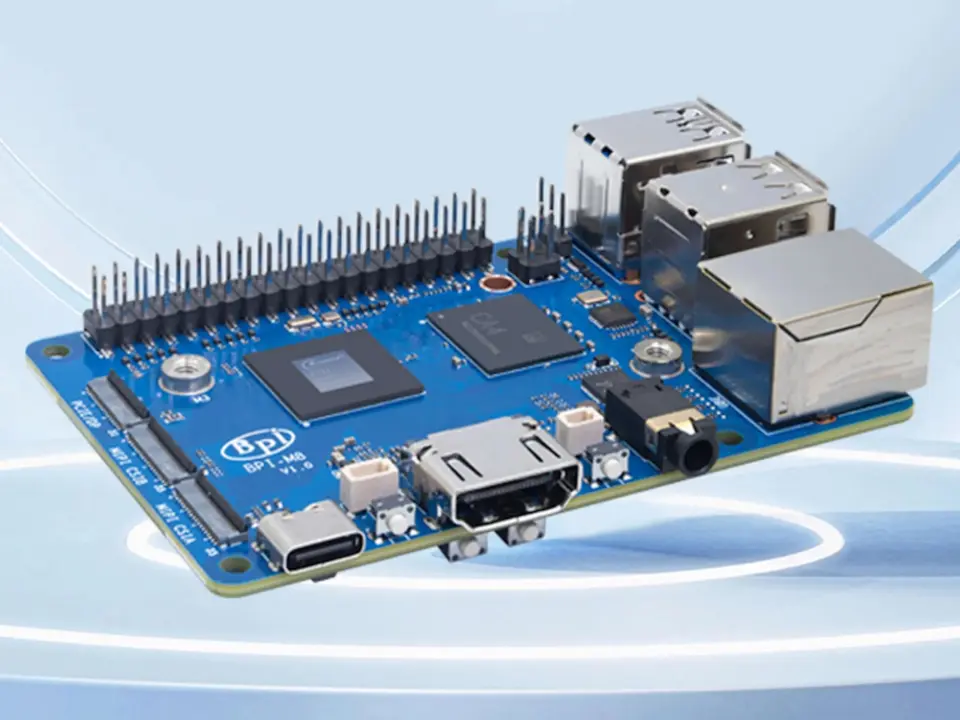
Banana Pi's BPI-M8 is a tiny single board computer that is competing head on with the Raspberry Pi world. This is significant because it provides a low cost alternative for those hobbyists and developers that require PCIe expansion with out paying for the premium model. This BPI-M8 is geared to those that are wanting a small form factor with the latest in connections at a low cost.
Banana Pi BPI-M8 specifications and pricing details
The BPI-M8's processor is based on the Allwinner A733 system on chip. This chip features a pair of Cortex-A76 cores and a set of six Cortex-A55 cores. This provides a nice balance of performance.
Specifications
- SoC: Allwinner A733
- CPU Configuration: 2x Cortex-A76 + 6x Cortex-A55
- RAM: 4GB LPDDR5
- Storage (Model A): 64GB eMMC (supporting 8GB-128GB)
- Connectivity: Gigabit Ethernet, Wi-Fi 6, Bluetooth 5.0
Banana Pi is providing two options, one with flash memory onboard (BPI-M8A) and the second without any flash (BPI-M8B). This gives users the choice of a ready to go model or one that they can do their own storage with a much lower cost.
To start the specs. This board features 4GB LPDDR5 memory. This gives you a faster memory bus than older DDR4 solutions.
BPI-M8A comes with 64GB eMMC memory but you can add an expansion card ranging from 8GB to 128GB. The networking is provided with Gigabit ethernet, Wi-Fi 6 and Bluetooth 5.0. This gives you a good range of wired and wireless connectivity for most projects.
The overall size is 56 x 85mm. This is one of the smallest form factors but still has full sized ports. It includes an HDMI 2.0b output, 3.5mm audio jack and a 40 pin GPIO header for interfacing to hardware.
There are 3 USB 2.0 ports and 1 USB 3.0 port. Also an FPC for PCIe expansion for adding accessories.
The pricing varies based on the storage. BPI-M8A will cost 103 USD and BPI-M8B will be 69 USD. This makes the BPI-M8 a good option for those that want to get into single board computing but need more than just the processing.
These can be bought directly from the manufacturer. Prices are clearly listed in dollars for worldwide use.

looks like a nice little box for the price tbh
I wonder if the Allwinner A733 has open source firmware available or if we are stuck with blob drivers again for the Wi-Fi module.
The specs list 4GB of LPDDR5 RAM which is a significant jump from the older DDR4 boards in this form factor.
is the $103 eMMC model worth the extra $34 over the base unit for long term reliability?
If you plan to run a database or store logs locally the eMMC speed and endurance will save you from micro SD card corruption issues.
I just want to know if it runs quiet under full load since there is no active cooling listed.
Specs on paper do not equal performance so I am waiting for independent benchmark numbers before spending any money.
Does the kernel support the PCIe FPC connector properly or is it just a hardware bridge without driver support yet.
finally a cheap board with actual USB 3.0 speed 🤔