

"ARM2 proved that architectural efficiency trumps clock speed." – Acorn Computers shipped the ARM2 processor in June 1987 for their Archimedes desktop. It was faster than competing x86 architectures (which clocked far faster) and helped set the stage for billions of mobile chips today.
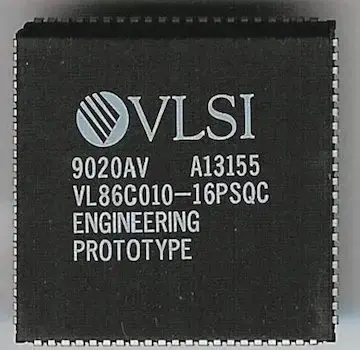
Acorn shipped the ARM2 processor in June 1987 for their Archimedes desktop
"ARM2 was a 32bit RISC processor designed by Acorn engineers Sophie Wilson and Steve Furber. It ran at 8MHz. It has about 30,000 transistors.
Specifications
- Clock Speed: 8MHz
- Transistor Count: 30,000
- Dhrystone Performance: 4901 Dhrystones per second
- Power Consumption: 0.1W at 10MHz
- Architecture: 32-bit RISC
That's far less than the complicated systems of the big manufacturers back then. They went out of their way to make things simple in order to keep instruction throughput high."
"It featured a 3 stage pipeline and conditional execution of every instruction. That meant they didn't have to deal with complicated flushing of the pipeline. It helped make instructions efficient.
Byte Magazine ran some tests on it in October 1987. They got 4901 Dhrystones/sec. That was 31% faster than the 16MHz Compaq Deskpro 386.
"Power was also super-low. The ARM2 drew 0.1W at 10MHz. That was an accidental by-product of design margins.
It wasn't the main focus. Apple used it as a target for their Newton handheld computer because it was so power efficient. There were lots of interest in this thing because of its design traits. It wasn't just for the desktop."
"Herman Hauser, co-founder of Acorn, quipped that they had two things going for them compared to big factories. No one and no money. ARM Ltd was a spin-off created by Acorn engineers in Nov 1990 to commercialize the technology. As of May 2026, ARM chip shipments hit 350B+." "ARM2 set the technical standard for that huge change in the industry."

Was the Dhrystone score from Byte Magazine the only independent verification or did Acorn run their own numbers? I want to see if the 31% lead over the Deskpro 386 held up under different loads.
The conditional execution on every instruction was the real key. It meant the three-stage pipeline never had to flush, which kept throughput high without needing the transistor budget of a complex x86 design.