
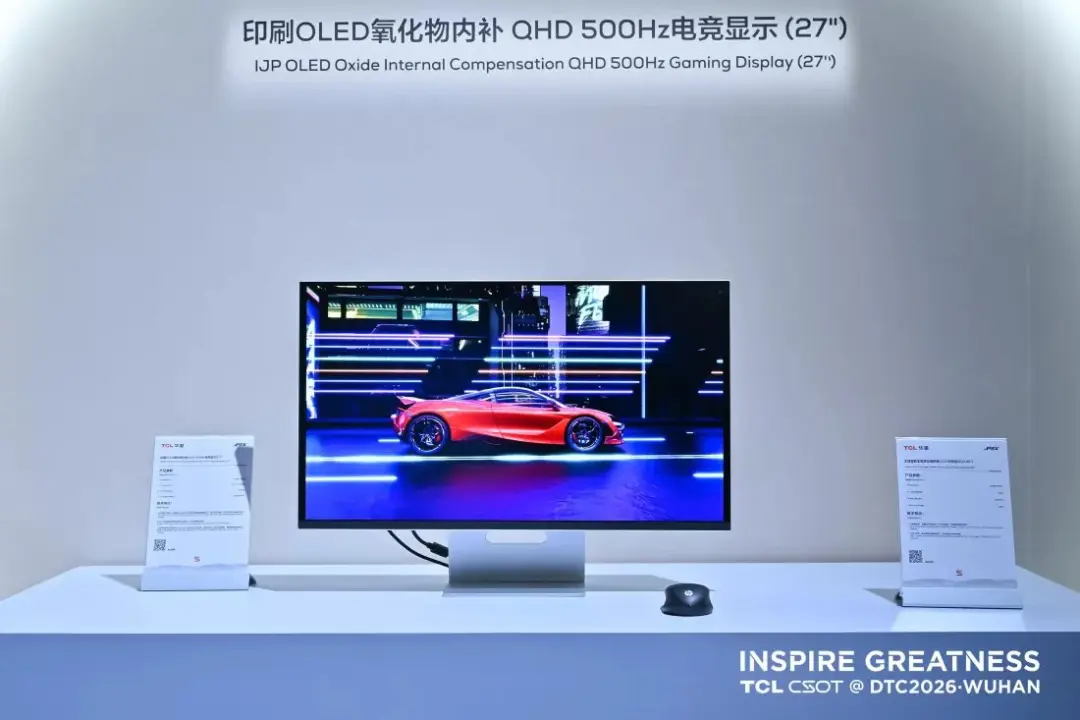
TCL CSOT has developed 27-inch 500Hz refresh rate OLED panel prototype. This directly answers one of the burning (sorry) issues with current top-end gaming displays: burn-in. With this technology, you can keep up maximum performance without having to pause to tend your screen.
TCL CSOT's new 500Hz OLED prototype eliminates the need for screen pauses to prevent burn-in
One less major hurdle to using an OLED in competitive gaming. With this announcement, we're looking at more robust and high-speed display solutions that we can use continuously rather than in carefully timed bursts.
Specifications
- Panel Size: 27-inch
- Refresh Rate: 500Hz
- Resolution: QHD
- Technology: Inkjet Printed OLED (IJP) with Oxide Backplane
- Burn-in Mitigation: Real-time background pixel compensation
The panel is based on an Inkjet Printed OLED (IJP) architecture with oxide backplane, which they claim is the most economical combination of these specific technologies in a panel system. Inkjet printing saves on organic waste compared to regular vacuum evaporation. That means it's simpler in its manufacturing process, which helps make this technology a potentially more economical choice for the mass-market gaming hardware scene than current OLED approaches.
A big part of what makes this panel prototype so impressive is the real-time pixel compensation to stave off burn-in while you use it. Per TCL CSOT, there's no need to manually power down your display for pixel refresh cycles like on current OLED monitors. TCL CSOT is touting this innovation as a solution to the usual high refresh rate vs display longevity issue. You get to keep things bright and colorful through some intensive gaming.
TCL is building a new IJP OLED production line in Guangzhou, where they're kicking off equipment installation starting October 31. Mass production should kick off in the 4th quarter of 2027. This is a pretty big timeline for availability. They're also aiming to do 32" and 34" panels with a 700Hz refresh rate in the future, suggesting we'll be seeing more of this high-speed OLED tech as time goes on.
There is some skepticism from industry folks who think that fast changes in brightness during gaming may still require you to use traditional cleaning techniques (TCL thinks you're good to go, though). We don't have clear details about when we can expect to see consumer monitors that use this 500Hz panel yet. We're just focused on the production line build right now.
This is the technical platform for the future displays. When you'll be able to get your hands on it will depend on the Guangzhou facility building out.
I need to see independent benchmark data before I buy into the 500Hz claims. What happens to latency when the pixel compensation overhead kicks in during intense scenes?
The oxide backplane should handle the switching speed, but you are right to be skeptical. Until a third party tests the input lag under load, the real-time compensation is just a spec on paper.
TFTCentral noted that rapid brightness changes in gaming might still require traditional cleaning. I doubt a background process can fully replace hardware-level fixes.