
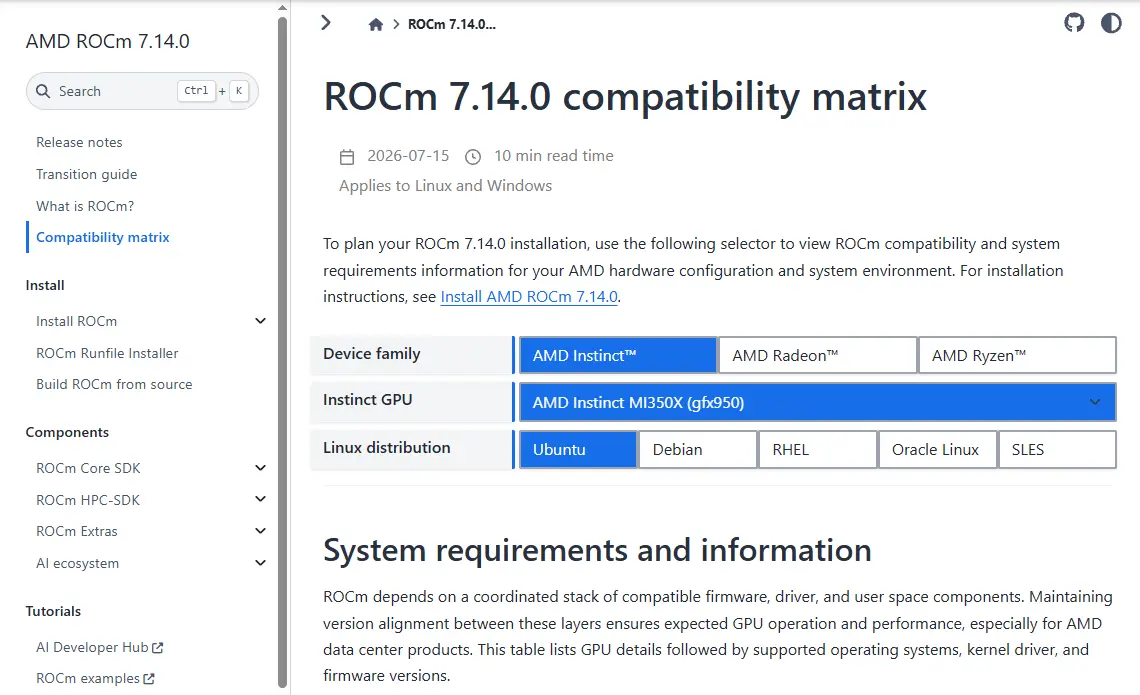
AMD released ROCm 7.14 as a stable software update ahead of its Advancing AI conference. This release matters because it marks the first time the platform officially supports the new Ryzen AI 400 series processors. Users and developers can now run AI workloads on these specific chips without relying on preview builds. The update also brings production support for the AMD Instinct MI350P PCIe GPU.
Stable release adds Ryzen AI 400 and Instinct MI350P support
The core change in this release is the introduction of TheRock, a new automated build system. TheRock replaces previous methods with a unified CMake-based approach for generating releases. AMD designed this system to streamline how the software is compiled and distributed. This shift aims to reduce complexity in the development pipeline for future updates.
ROCm 7.14 expands hardware compatibility to include seven new Ryzen AI APUs. These models cover the Ryzen AI Max+ PRO 495, PRO 490, and PRO 485, along with the Ryzen AI 430 and 440. The platform also adds official support for several Linux distributions. Compatible operating systems now include RHEL 9.8, RHEL 10.2, SLES 15 SP7, SLES 16, and Debian 13.
Framework support has been updated to include PyTorch 2.12 and JAX 0.10.0. AMD enhanced HIP to improve compatibility with CUDA codebases. The company states that these changes improve GPU virtualization and AI inference performance. AMD documentation explicitly encourages users on version 7.2 or earlier to migrate to this stable release.
We looked at the last ROCm update while tracking AMD's software progress. That previous coverage highlighted similar themes of balance and stability that appear here. ROCm 7.14 solidifies the foundation for upcoming AI hardware deployments. The stable release removes the need for developers to test pre-release versions on supported platforms.


Discussion
0 comments
Log in to join the thread with a thoughtful take, question, or correction.