
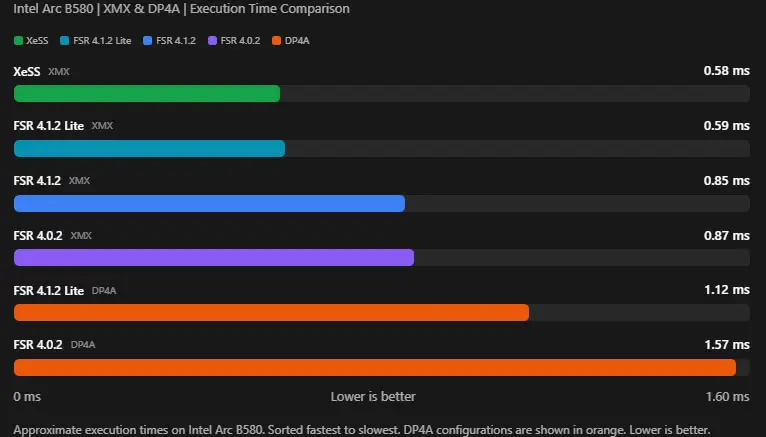
AMD FSR 4.1.2 upscaling can now be used on Intel Arc GPU thanks to a community software project called OptiScaler. Such modification is important as it makes it possible to use on Intel's hardware, a common upscaling solution without needing to resort to lesser performant methods. This means that all gamers with Intel's hardware can now take advantage of FSR's ecosystem without sacrificing performance that is on par with Intel's own XeSS.
OptiScaler project replaces slow DP4a fallback with native XMX implementation
The modification in question specifically addresses the Intel Arc B580 GPU and takes advantage of XMX (Xe Math Extensions) cores for execution. Normally, FSR implementations on Intel's hardware would instead resort to low performing DP4a instructions which causes a huge performance hit. This OptiScaler project instead incorporates a native XMX implementation to bring the rendering solution closer to Intel's own AI acceleration hardware.
When tested in 'Clair Obscur: Expedition 33' game, the patched FSR 4.1.2 Lite performs practically the same as native XeSS. The FSR 4.1.2 Lite upscaling time was clocked at 0.59ms, and native XeSS (SR) was at 0.58ms. 0.01ms difference is quite minor so it looks like this community patch does a great job at narrowing the gap between AMD and Intel's native performance.
Earlier OptiScaler updates have also talked about how difficult it can be to balance compatibility and rendering quality. The newest version is mainly focused on bringing FSR to platforms that had it limited to inefficient software implementation. With this, the toolbox is further expanded for Intel Arc owners who may want AMD's upscaling algorithms on certain games.

Discussion
0 comments
Log in to join the thread with a thoughtful take, question, or correction.