
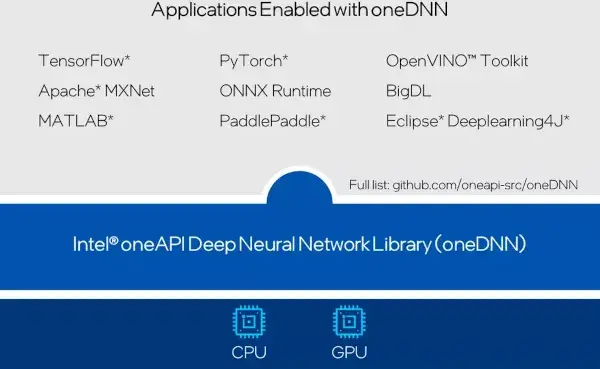
AMD and Intel are taking a major step towards unifying the long-standing split in software support for their respective x86 processors. The consolidation of software efforts is streamlining the deep learning experience by integrating AMD's ZenDNN optimization solution directly into Intel's open-source oneDNN library. This consolidation means that the default acceleration backend for x86 processors will now be oneDNN in PyTorch – no longer requiring the burden of split software efforts.
Unified library simplifies PyTorch backend for x86 developers
This consolidation has been made possible through a concerted push from x86 Ecosystem Advisory Group towards a unified software approach. AMD has also now become a guiding committee member of the UXL Foundation to directly govern the oneDNN project. This new structure sees AMD and Intel shoulder-to-shoulder governing the library that drives much of today's AI development.
Central to the consolidation efforts is the collaboration around improving the AI Compute Extensions (ACE) – the matrix multiplication instruction sets intended to optimize the deep learning experience across both AMD and Intel architectures. These unified instruction sets will get integrated into oneDNN which enables sharing a single codebase to take advantage of architecture-optimized code from both vendors without separate maintenance branches.
This consolidation removes the friction of developers having to pick a competing acceleration backend when working with x86. The unified library approach helps cut the complexity around testing and maintaining separate software branches catering to different CPU vendors. It points to a larger trend around establishing common ground in the software stack underpinning AI computing workloads on x86 platforms.

Discussion
0 comments
Log in to join the thread with a thoughtful take, question, or correction.