
Microsoft is preparing to launch the Surface Laptop Ultra, a device that shifts the high-end laptop market by pairing a 15-inch mini-LED screen with NVIDIA silicon. This configuration matters because it challenges the long-standing dominance of Apple's M-series chips in the premium portable space. Buyers who prioritize GPU acceleration and Windows compatibility now have a new contender to evaluate before the 2026 release window.
NVIDIA silicon challenges Apple dominance in premium laptops
The laptop houses the NVIDIA N1X processor, a 20-core chip that combines ten high-performance Cortex-X925 cores with ten efficiency Cortex-A725 cores. Microsoft has confirmed the system will support up to 128GB of unified memory to handle heavy workloads. The device also integrates a Blackwell GPU featuring 48 Streaming Multiprocessors and 6,144 CUDA cores for graphics-intensive tasks.
Specifications
- CPU: NVIDIA N1X (20-core: 10x Cortex-X925 + 10x Cortex-A725)
- GPU: Blackwell with 48 SMs and 6,144 CUDA cores
- Display: 15-inch mini-LED
- Memory: Up to 128GB unified
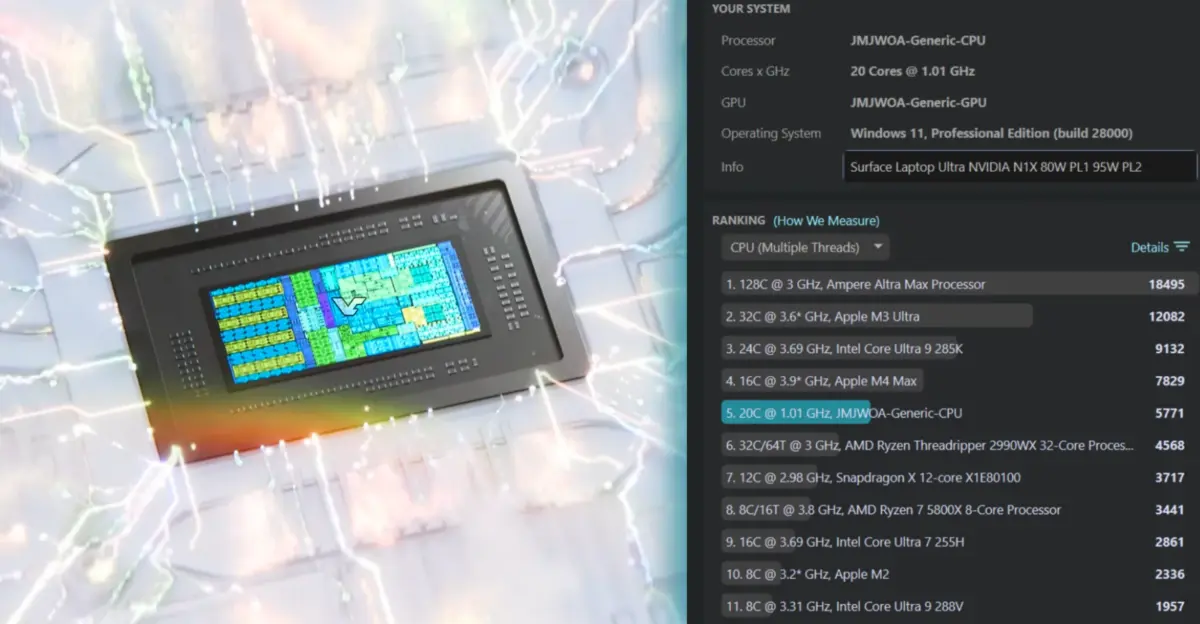
- Cinebench 2026 Multi-thread Score: 5,771 points
Early benchmark results from Cinebench 2026 show the N1X scoring 5,771 points in multi-thread tests and 540 points in single-thread tests. These figures place the chip in direct competition with Apple's 14-core M3 Max, which trails by roughly one percent in multi-thread performance but leads by four percent in single-thread speed. The 16-core M3 Max variant remains fourteen percent faster in multi-thread workloads while maintaining its single-thread advantage.
Power management plays a critical role in the N1X performance profile, with default limits set at 37.5W PL1 and 64W PL2. A hidden High Performance profile discovered by testers raises these limits to 80W PL1 and 95W PL2, allowing for sustained higher throughput. Benchmarks currently identify the processor as 'JMJWOA-Generic-CPU' with a fixed 1.01 GHz clock, which reflects a pre-release platform identification issue rather than the actual operating frequency.
NVIDIA RTX Spark laptops based on the N1X chip are scheduled to become available globally in fall 2026. We looked at earlier RTX Spark developments while tracking these hardware leaks.
Discussion
0 comments
Log in to join the thread with a thoughtful take, question, or correction.