
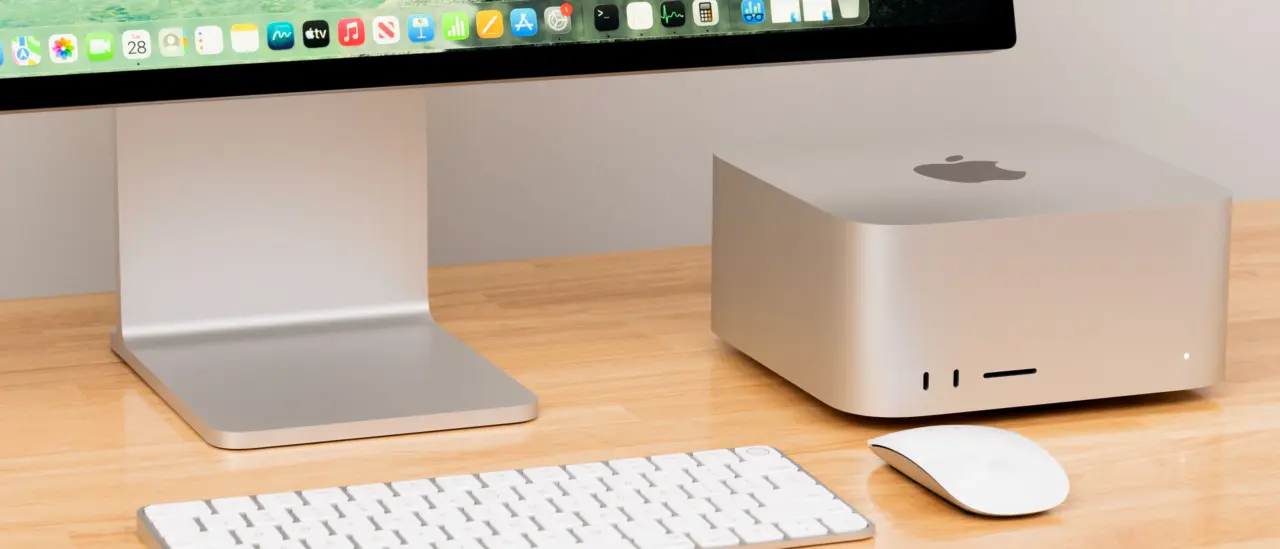
Apple’s Mac Studio with the M5 Ultra chip is reshaping local AI inference benchmarks by outperforming Nvidia’s DGX Spark in speed and efficiency. This matters because the Mac Studio offers a single-system alternative to the expensive dual-node clusters typically required for large language models. Buyers needing high memory capacity and energy efficiency now have a viable competitor to traditional GPU workstations.
Apple Mac Studio M5 Ultra benchmarks against Nvidia DGX Spark in local AI inference tests
The system features a 36-core CPU and an 80-core GPU equipped with Neural Accelerators for matrix math operations. It supports up to 512GB of unified memory with 1.2 TB/s of bandwidth. These specifications allow the machine to handle dense models that would typically overwhelm smaller consumer devices.
Spec comparison
| Spec | Mac Studio M5 Ultra | Nvidia DGX Spark |
|---|---|---|
| CPU | 36-core | Information insufficient |
| GPU | 80-core GPU with Neural Accelerators | 48 Blackwell SMs |
| Unified Memory | up to 512GB | Information insufficient |
| Memory Bandwidth | 1.2 TB/s | Information insufficient |
| Price | $12,300 or more | Information insufficient |
In the AgentPerf-Local agentic test, the M5 Ultra Mac Studio finishes tasks in just under half the time of a single DGX Spark-like system. It also consumes about 16% less task energy overall during this test. The Mac Studio’s Energy-Delay Product is under half that of the DGX Spark for dense models like Qwen 3.8 27B.
For larger models such as DeepSeek V4.1 Flash 1017 and GLM 5.3 Flash, a dual-DGX Spark cluster outperforms the single Mac Studio due to higher memory capacity. However, the TensorFold inference engine on the Mac Studio delivers decode throughput three times faster than llama.cpp for GLM 5.3 Flash. Dell Pro Precision GB10 systems cost around $10,000 each, making a dual cluster cost $15,000 to $20,000 or more.
The Mac Studio is priced at $12,300 or more, positioning it as a competitive alternative for high-memory needs compared to the $15,000+ cost of dual DGX Spark setups. Current support for some models relies on llama.cpp, which performs poorly, but improved inference engine support via MLX/TensorFold is expected to arrive in time. We’ve been tracking Mac Studio closely — see our earlier coverage on Apple Mac Studio M5 Ultra Rumors.
Tom’s Hardware notes that the M5 Ultra’s 80-core GPU dwarfs the GB10’s 48 Blackwell SMs at a high level. They state that even without detailed info on clocks, it would be extremely difficult for GB10 to outgun the M5 Ultra in this test. The Mac Studio ships with significant lead times, taking 13 to 15 weeks initially, with lead times stretching into February 2027.


Comments (0)