
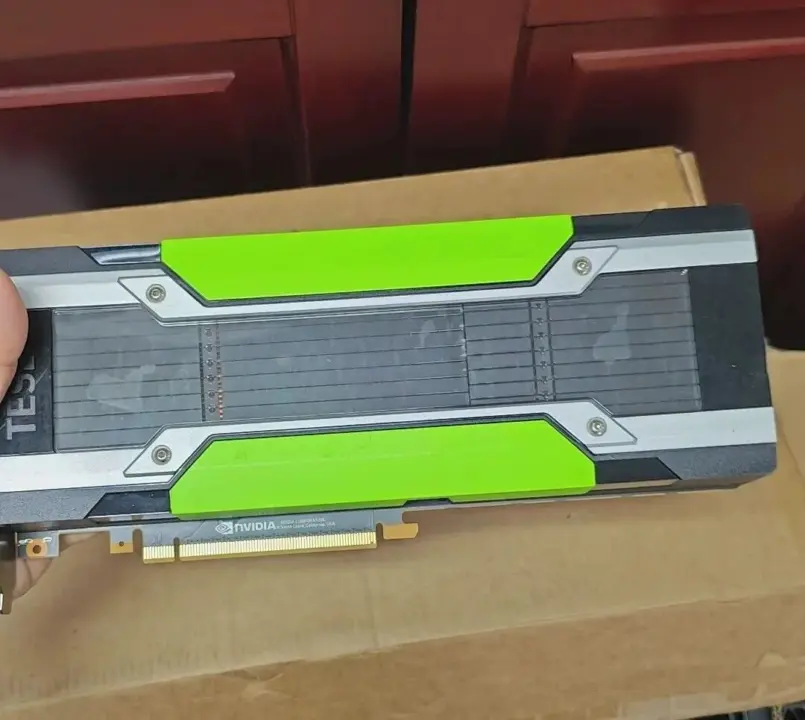
We often assume older hardware is useless for modern AI workloads, but a new software tweak proves otherwise. A developer has optimized the ik-llama.cpp framework to breathe new life into NVIDIA's Pascal architecture. This matters because it allows users to run substantial large language models on cards that were previously considered too slow or incompatible. You can now repurpose retired enterprise GPUs for practical inference tasks without buying new equipment.
Custom kernels unlock 35B parameter model support on legacy hardware
The focus of this optimization is the NVIDIA Tesla P100, a Pascal-based graphics card with 16GB of VRAM. The developer specifically targeted the ik-llama.cpp software stack to support both Pascal and Volta architectures. This update enables the P100 to handle 35 billion parameter Mixture of Experts (MoE) models. The card joins the P40 and V100 in the list of supported legacy hardware for this specific workflow.

The technical results show significant performance gains over the previous baseline. Prefill speed increased by 88%, which reduces the latency before the model starts generating text. Decode speed also improved by 30%, making the token generation process noticeably faster. These improvements come from custom optimized kernels that better utilize the older hardware's capabilities.
Implementing this solution requires more than just installing a standard driver. Users must manually compile the software from GitHub and configure custom cooling solutions for the cards. The specific benchmark tools and exact baseline metrics for the speed claims are not detailed in the source report. This approach is best suited for developers and hobbyists willing to tinker with their hardware setups.
The developer shared these results on social media as a proof of concept for legacy hardware reuse. The optimization demonstrates that software efficiency can sometimes outweigh raw hardware generational gaps. We looked at similar legacy GPU optimizations earlier while tracking cost-effective AI inference methods. The confirmed facts are limited to the reported speed increases and the supported model list.
Discussion
0 comments
Log in to join the thread with a thoughtful take, question, or correction.