

AMD has taken the wraps off its Helios rack-scale AI platform at Computex 2026. The system targets large-scale AI training and inference workloads, positioning itself as a direct competitor to Nvidia's NVL72 VR200.

Helios combines EPYC Venice CPUs with 72 MI455X accelerators
Helios combines AMD's 6th Generation EPYC Venice CPUs with up to 256 cores and 72 Instinct MI455X accelerators. The platform also includes Pensando Vulcano network interface cards, which are among the industry's first 800 GbE NICs.
Spec comparison
| Spec | Helios MI455X |
|---|---|
| CPU | 6th Gen EPYC Venice up to 256 cores |
| AI Accelerators | 72 Instinct MI455X |
| HBM4 Memory | 31 TB |
| Memory Bandwidth | 1400 TB/s |
| Compute Performance | ~2900 FP4 dense PFLOPS |
The system packs 31 TB of HBM4 memory and delivers 1400 TB/s of memory bandwidth. Compute performance reaches around 2900 FP4 dense PFLOPS. Initial systems use UALink-over-Ethernet interconnects, providing up to 260 TB/s aggregated scale-up bandwidth and 43 TB/s scale-out bandwidth.
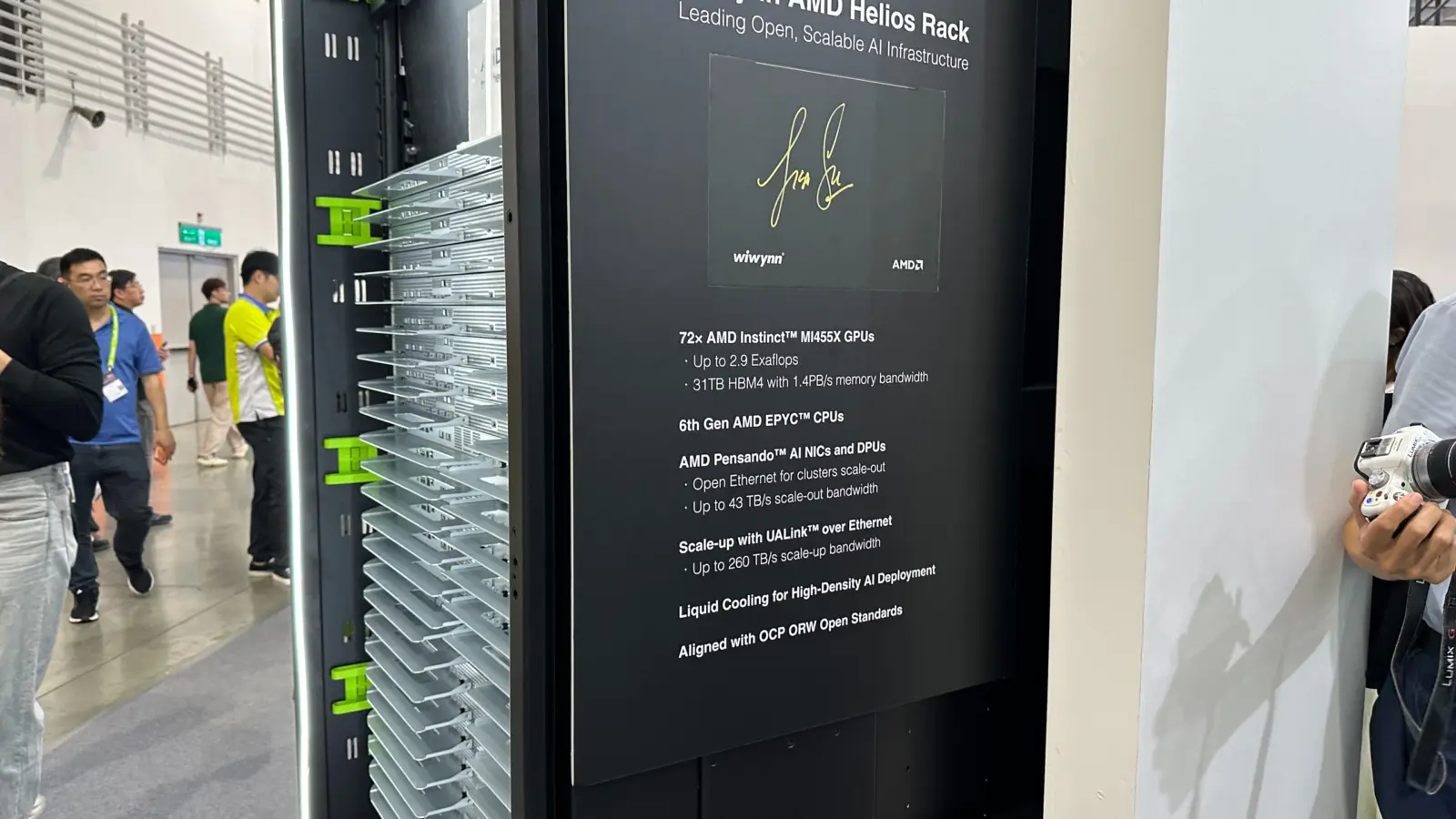
UALink-over-Ethernet may introduce higher latency and overhead
UALink-over-Ethernet may introduce higher latency and overhead compared to a dedicated fabric, as Ethernet was originally designed as a general-purpose networking technology. True UALink versions are expected to follow later.
Helios is set to become available globally later this year. Pricing has not been announced.
On paper, Helios with UALink-over-Ethernet matches Nvidia's NVL72 VR200 in scale-up bandwidth. The larger HBM4 capacity gives Helios an advantage in memory-intensive workloads, according to Tom's Hardware.
The Helios platform is confirmed with the specs and availability window described. No further details on true UALink timing or next-generation successors have been provided.


Discussion
0 comments
Log in to join the thread with a thoughtful take, question, or correction.