
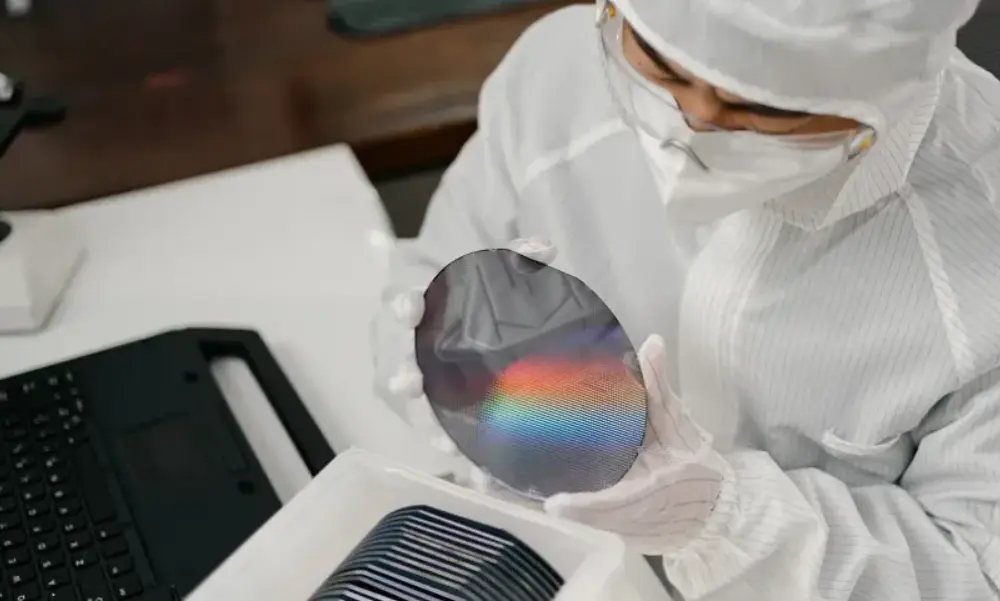
Suzhou Zhixin Sensing Technology Co., Ltd. has released a public version of its MEMS micromirror large array chip, a move that directly impacts the supply chain for AI data centers. This launch addresses a critical bottleneck in optical switching core components, offering a domestic alternative to previously monopolized overseas technology. Buyers relying on all-optical interconnection infrastructure now have a new local source for these essential hardware elements.
Suzhou Zhixin Sensing Technology releases a public MEMS micromirror large array chip designed for AI data center optical switching infrastructure.
The chip integrates 416 independent micromirror units on a single silicon substrate, utilizing an electrostatic drive dual-axis MEMS structure. Each micro-mirror unit deflects up to ±6.5 degrees on the X-axis and ±5.5 degrees on the Y-axis to direct light signals. The device maintains infrared reflectivity of at least 96 percent, ensuring efficient signal transmission within optical networks.
Specifications
- Micro-mirror units: 416
- Deflection angle: ±6.5° (X-axis), ±5.5° (Y-axis)
- Infrared reflectivity: ≥96%
- Response time: ≤10ms
- Cycle life: >1 billion cycles
Technical specifications highlight a response time of 10 milliseconds or less and a cycle life exceeding one billion cycles. The package dimensions measure 33.6mm by 20.85mm by 0.66mm, allowing for dense integration in server racks. The company reports a manufacturing yield rate stable at over 90 percent, supported by 6-inch and 8-inch MEMS wafer production lines with a monthly capacity of 10,000 wafers.
This component targets All-Optical Switching (OCS) systems for AI computing clusters, supporting a port scale of 400×400. Industry experts state that this release breaks the overseas monopoly in optical switching core components and provides a solid foundation for autonomous and controllable all-optical interconnection. The company aims to expand its roadmap toward 1024×1024 port specifications in the future.
The standard public version chip launched in China in August 2026 for industry customers. This release marks a substantial step in the localization process of all-optical switching technology in China. We looked at the broader context of domestic semiconductor advancements while tracking these AI infrastructure developments.


Discussion
0 comments
Log in to join the thread with a thoughtful take, question, or correction.