
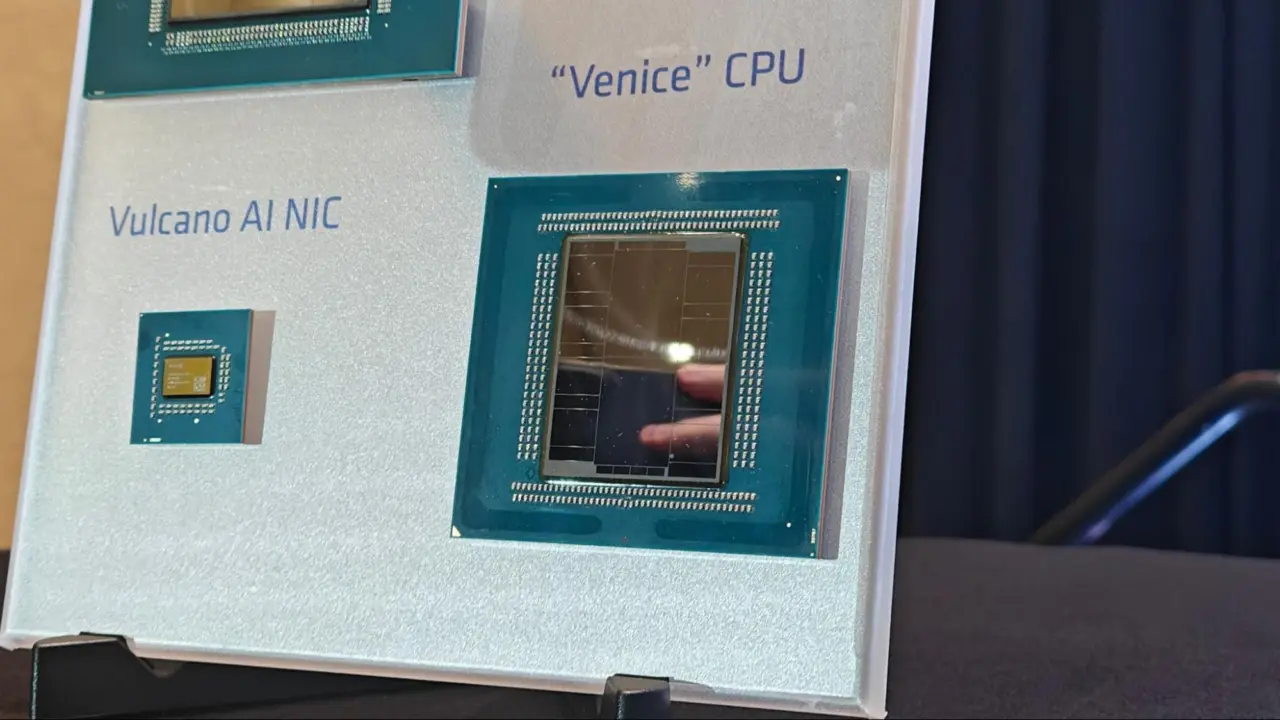
Server buyers evaluating AMD’s Zen 6 architecture against Nvidia’s Vera now have concrete benchmark data to consider. AMD claims its new Epyc 9996 Venice processor delivers 2.2 times the throughput of Nvidia’s competing chip in SPEC CPU 2026 tests. The benchmark results indicate performance differences between the two processors, though specific cost-to-performance impacts for large language models are not detailed in the provided data. These benchmark results provide data points that organizations may consider when evaluating processor performance and power specifications.
AMD executive notes 20 percent advantage over Nvidia Vera in SPEC CPU 2026 tests
The comparison pits AMD’s 256-core Epyc 9996 against Nvidia’s 88-core Vera processor. AMD’s Epyc 9996 is rated at 600W, while the source notes a 96-core Epyc model with a 500W rating, indicating varying power specifications across the product line. AMD’s Venice architecture achieves a SPECrate_int score of 2,070 in these integer workloads. Nvidia’s Vera processor scores 925 in the same benchmark suite. The benchmark scores show that the 256-core Epyc 9996 achieved a higher SPECrate_int score than the 88-core Vera.
Spec comparison
| Spec | AMD Epyc 9996 | Nvidia Vera | AMD Epyc 9686F |
|---|---|---|---|
| Core Count | 256-core | 88-core | 96-core |
| TDP | 600W | N/A | 500W |
| SPECrate_int Score | 2,070 | 925 | 1,210 |
AMD executive Ravi Kuppuswany highlighted the unexpected margin in these results during a recent discussion. He stated that the company initially expected to beat Nvidia by only 10 percent. The actual 20 percent advantage exceeded their internal projections. Kuppuswany noted that the tuning process for the Venice architecture is still ongoing. He expressed satisfaction that Nvidia published their Vera performance numbers, which validated AMD’s conservative internal estimates.
The data also includes a comparison with AMD’s own 96-core High Frequency Epyc 9686F processor. That chip achieved a SPECrate_int score of 1,210 in the same tests. The 256-core Venice chip outperforms the 96-core variant by a wide margin. The performance data shows a correlation between the higher core count of the Epyc 9996 and its higher throughput score compared to the Vera. AMD reports that its 96-core High Frequency Epyc CPU achieved a SPECrate_int score of 1,210, which is lower than the 2,070 score of the 256-core Epyc 9996.
Industry analysis notes that comparing a 256-core chip to an 88-core chip creates a skewed view of per-core efficiency. AMD claims a 1.2x faster per-core performance for the Venice architecture, alongside a 2.2x higher throughput compared to the Vera. AMD claims 1.2 times faster per-core performance, but this metric requires careful interpretation given the core disparity. The Epyc 9996 features 256 cores, which represents a significant increase in core density compared to the 88-core Vera. The comparison between the 256-core Epyc 9996 and the 88-core Vera illustrates the performance differences between processors with varying core counts.
Discussion
0 comments
Log in to join the thread with a thoughtful take, question, or correction.