
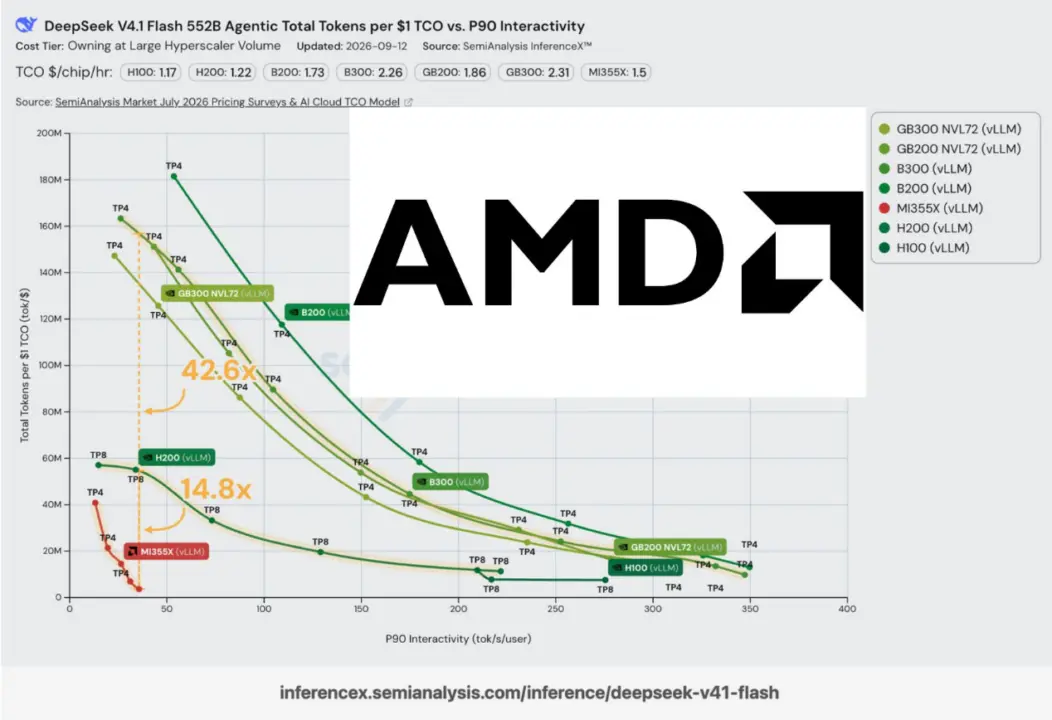
DeepSeek’s latest V4.1 Flash model reinforces NVIDIA’s dominance in the AI inference market by highlighting a stark performance gap between its CUDA ecosystem and AMD’s competing hardware. This matters to buyers and infrastructure managers because immediate deployment capabilities and raw speed directly impact operational costs and time-to-market for AI services. NVIDIA GPUs run the model out of the box, while AMD systems face significant delays and performance penalties. The findings suggest that switching to AMD for this specific workload requires accepting substantial efficiency losses.
AMD MI355X throughput trails NVIDIA H200 and B200 by massive margins
The core of the issue lies in the software compatibility layers between the DeepSeek model and the two major GPU vendors. NVIDIA’s CUDA platform allows the V4.1 Flash model to start running immediately upon release without additional configuration. AMD released a specific image for the model two days after the official launch, indicating a necessary optimization period. This delay forces AMD users to wait for software readiness before they can utilize their hardware for this workload.
Performance benchmarks conducted by SemiAnalysis reveal the extent of this disparity. The AMD MI355X GPU achieved a throughput of under 50 tokens per second during testing. This speed is 14.8 times slower than the NVIDIA H200 GPU. When compared to the newer B200 and B300 GPUs, the AMD hardware falls behind by a factor of 42.6. These metrics demonstrate that the AMD MI355X struggles to match the computational efficiency of NVIDIA’s current generation AI accelerators.
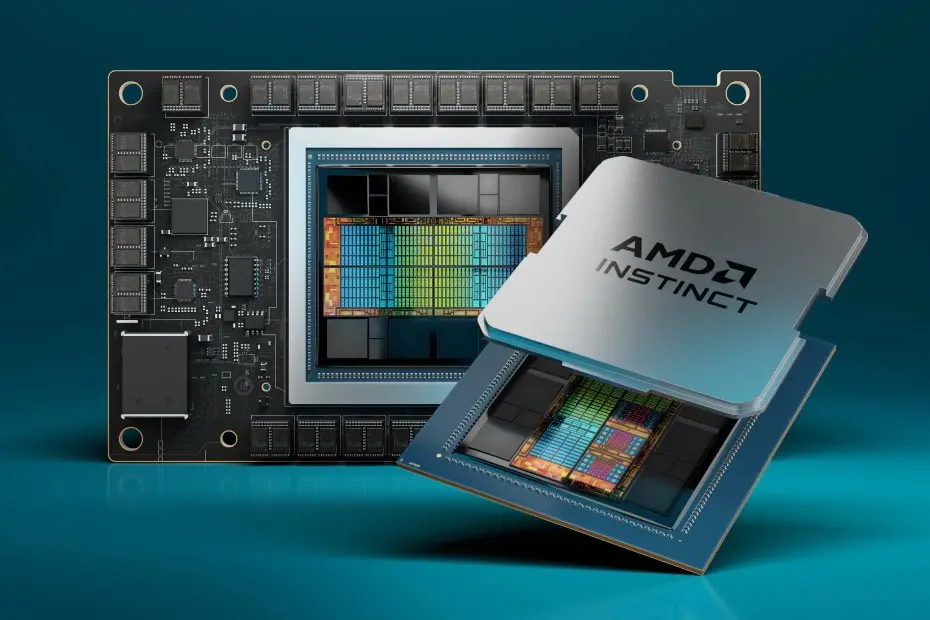
The performance gap translates into a significant disadvantage for AMD in terms of cost-effectiveness for this specific AI task. The source indicates that AMD’s cost-effectiveness is worse by more than 40 times compared to NVIDIA. This implies that even if AMD hardware is cheaper upfront, the slower inference speed drives up the cost per token. NVIDIA’s ecosystem provides superior business stability by eliminating the need for extended optimization windows.
We looked at Google TPU Ironwood Beats NVIDIA B200 earlier while tracking NVIDIA launches. That coverage highlights the competitive landscape where hardware efficiency directly influences inference costs. The V4.1 Flash results confirm that NVIDIA’s software moat remains a critical barrier for AMD in the AI inference sector. Organizations relying on this model must weigh the immediate availability of NVIDIA against the delayed and slower AMD alternative.
Discussion
0 comments
Log in to join the thread with a thoughtful take, question, or correction.