
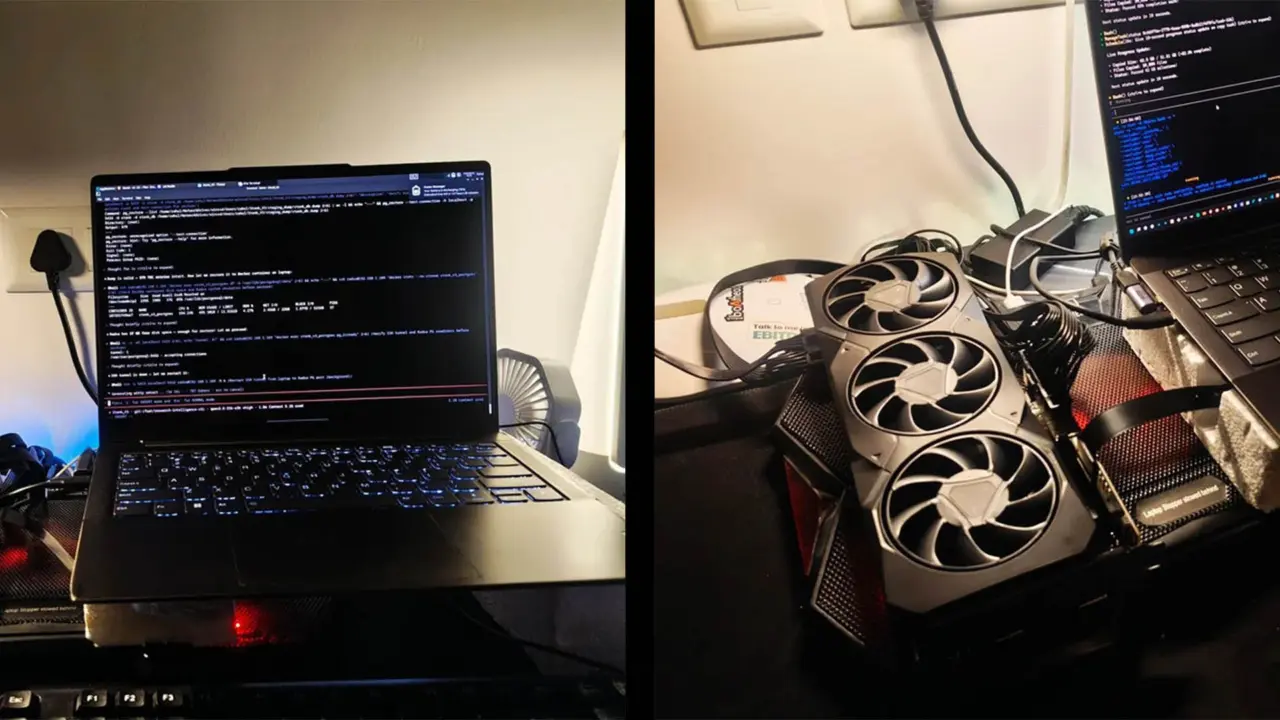
A user has successfully connected a desktop graphics card to an older laptop to run local AI models, proving that external GPU setups can handle demanding generative workloads. This experiment matters because it shows that even aging laptops with limited internal storage and processing power can serve as viable terminals for high-performance AI inference when paired with the right hardware adapters. It offers a practical path for enthusiasts who want to experiment with large language models without investing in a new, expensive machine.
User connects desktop GPU to aging laptop via M.2 slot for local AI inference
The project centers on a Lenovo laptop running the Qwen3.6 27B model, a large language model that requires significant memory and processing power. The user paired this software with an AMD Radeon RX 7900 XT desktop GPU, which provided the necessary 20GB of GDDR6 VRAM to store the model weights and key-value cache. By offloading the heavy lifting to the external graphics card, the system could process complex queries that would typically overwhelm a standard laptop's integrated graphics or CPU.
- GPU: AMD Radeon RX 7900 XT
- GPU VRAM: 20GB GDDR6
- Inference Speed: 55-60 tokens/second
- Model: Qwen3.6 27B
- Context Window: 100K tokens
To make this connection work, the user employed an ADT-Link PCIe riser adapter plugged into the laptop's only available M.2 slot. Since the internal drive was occupied by the operating system, the user booted Windows from an external drive to free up the M.2 port for the GPU connection. The setup also required a separate 750W power supply to provide adequate energy to the high-draw RX 7900 XT, as the laptop's internal power delivery could not support the desktop card.
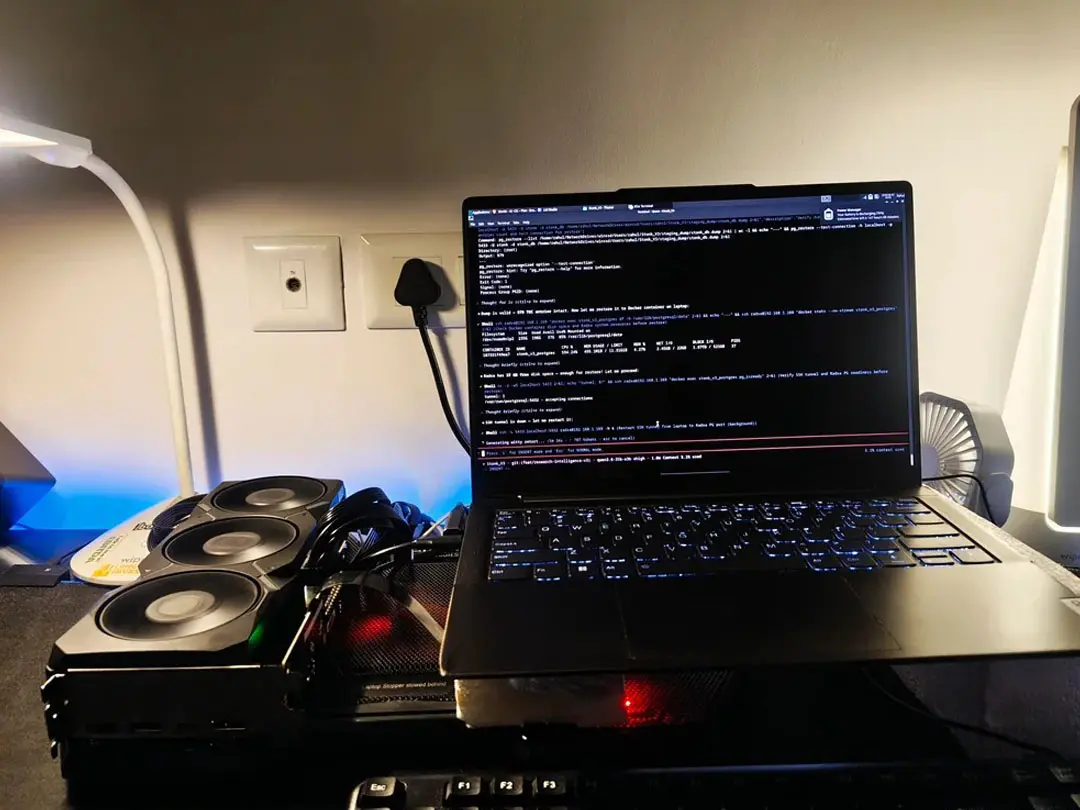
Performance testing with the llama.cpp framework showed the system achieving inference speeds of 55 to 60 tokens per second. However, the 100K token context window filled the laptop's entire 16GB of system RAM, creating a bottleneck that the source noted might affect smoothness. While the raw token generation rate was impressive, the heavy reliance on system memory for the context window means that users with less than 16GB of RAM would likely struggle to run this specific configuration effectively.
We looked at similar external GPU hacks earlier while tracking hardware modification trends. The experiment confirms that desktop GPUs can be repurposed for AI tasks on older hardware, provided users have the necessary adapters and power supplies. This approach allows users to extend the life of their laptops for specific high-performance tasks without replacing the entire system.
Discussion
0 comments
Log in to join the thread with a thoughtful take, question, or correction.