
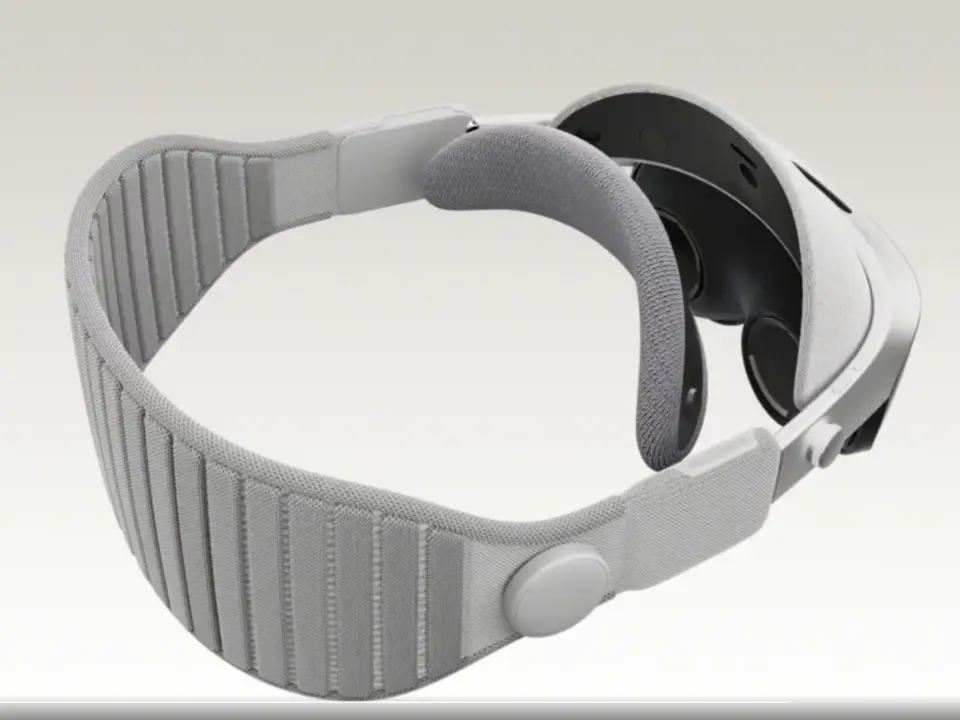
Leaked visuals from a public software development kit show the first detailed look at Pico's Project Swan mixed reality headset. The footage reveals a design that borrows elements from Apple Vision Pro and Samsung Galaxy XR headsets, including side-mounted controls and detachable battery packs with USB-C ports. This preview establishes the hardware direction for Pico's next-generation platform before its planned global launch in late 2026.
Leaked SDK footage reveals the design and hardware specifications of Pico's upcoming mixed reality headset.
Project Swan runs on a dual-chip architecture that separates processing tasks between two distinct components. A custom-built chip named 'Pico Silicon' handles sensing, spatial computing, and image processing duties. The device also pairs this with a flagship system-on-chip to manage general compute workloads.
- Displays: Dual 4K Micro-OLED displays with a pixel density approaching 4,000 pixels per inch and up to 40 pixels per degree (peaking at 45 PPD)
- Processor: Dual-chip architecture: custom 'Pico Silicon' processor for sensing/spatial computing/image processing + flagship SoC (claims >2x CPU/GPU performance vs Qualcomm XR2 Gen 2)
- Latency: End-to-end mixed reality latency of just 12 milliseconds
- OS: Pico OS 6 with new Spatial Engine layer for Android app integration, PanoScreen feature
- Launch Date: Late 2026
The headset features dual 4K Micro-OLED displays that deliver pixel densities approaching 4,000 pixels per inch. Visual clarity reaches up to 40 pixels per degree across the field of view and peaks at 45 PPD in the center of the viewing area. The company claims an end-to-end mixed reality latency of just 12 milliseconds for responsive tracking.
Pico OS 6 supports the hardware with a new Spatial Engine layer that integrates standard Android applications directly into immersive environments. Users can position multiple application windows around them in a 360-degree workspace using hand gestures, controllers, keyboards, or mice. The leaked SDK footage confirms these interface capabilities alongside motion tracking and detachable battery designs.
Pico claims the flagship system-on-chip delivers more than twice the CPU and GPU performance of Qualcomm's XR2 Gen 2 platform. This performance target positions Project Swan as a high-end competitor in the mixed reality market, though exact pricing remains unconfirmed. The device targets global availability starting in late 2026.
The leaked SDK visuals were shared on X by user Luna, who claimed independent verification of their authenticity before official confirmation from Pico. Further details and demonstrations are expected at GDC 2026 to validate the hardware specifications and design choices outlined in the leak.

Discussion
0 comments
Log in to join the thread with a thoughtful take, question, or correction.