
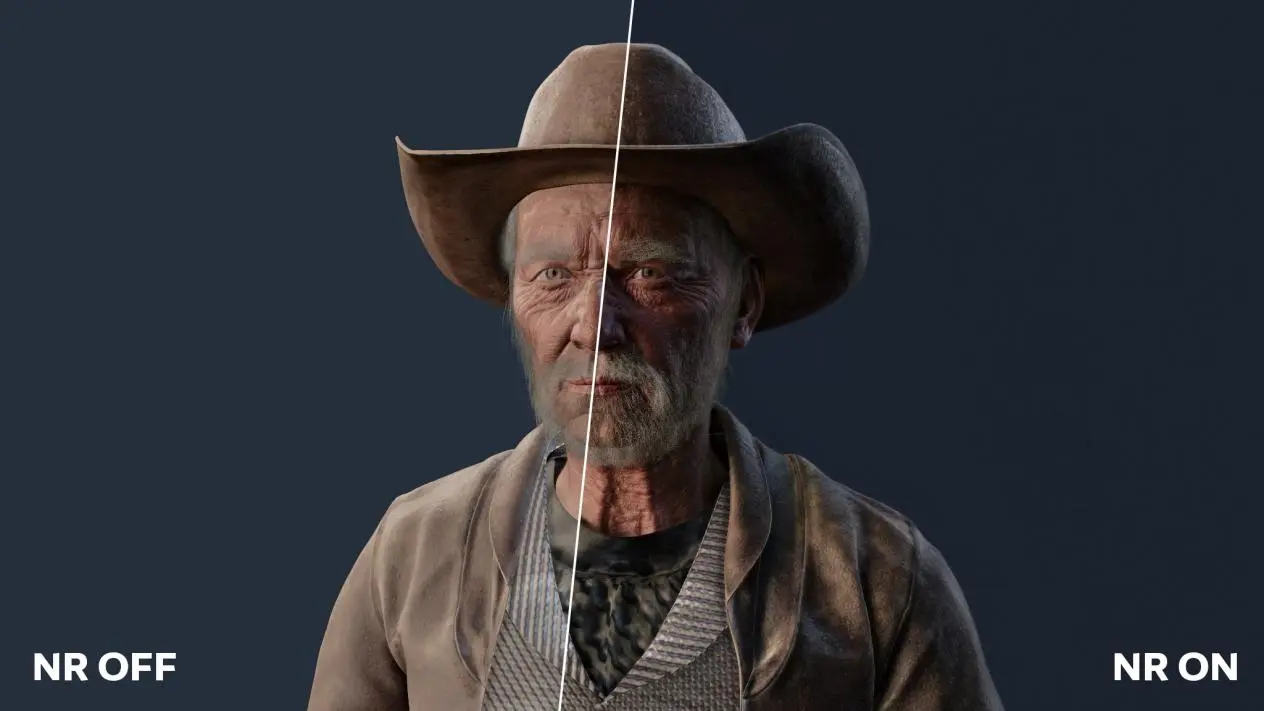
Developers have successfully reverse-engineered NVIDIA's DLSS 5 neural rendering network, creating an open-source implementation that runs on older hardware. This breakthrough matters because it breaks the artificial restriction that limits DLSS 5 to the upcoming RTX 50 series. Users with current generation cards can now access the technology without waiting for new silicon. The project, named OpenDLSS-NR, proves that the underlying AI model is not locked to proprietary hardware features.
Open-source Vulkan implementation breaks hardware restrictions for DLSS 5
Developer MAAN released OpenDLSS-NR as a Vulkan reimplementation of the DLSS 5 runtime DLL version 310.8.0. The core achievement lies in reproducing 71 specific neural network structures from the official software. The model uses a U-Net architecture that combines shifted window transformers with global visual transformers. It processes data using FP8 activation and FP16 accumulation precision. The total model weight size is approximately 141MiB.
Performance testing on an RTX 4070 SUPER demonstrates that the network runs efficiently on Ada Lovelace architecture. At a 768×768 resolution, the inference time is just 2.8 milliseconds. Execution takes 7.8 milliseconds at 1080p, 12.6 milliseconds at 1440p, and 29.3 milliseconds at 4K. A WebGPU version also exists, allowing the network to run in modern web browsers. This browser version operates without NVIDIA Tensor Cores or native FP8 support, proving the model can be decoupled from NVIDIA hardware entirely.
The implementation claims to produce output that is bit-for-bit identical to NVIDIA's official version. This accuracy extends to all 75 intermediate block boundaries within the neural network. The repository does not include NVIDIA's proprietary model weights, so users must provide them manually. OpenDLSS-NR is a standalone implementation with a demo renderer based on the Google Filament engine. It is not a ready-to-use game mod but a technical proof of concept. The project confirms that DLSS 5 capabilities are accessible on non-RTX 50 GPUs.
This release shifts the focus from hardware exclusivity to software accessibility for advanced upscaling. Developers can now experiment with DLSS 5 logic on existing RTX 40 series cards. The WebGPU port further expands potential use cases into web-based applications. Users interested in the technology must locate and supply the necessary model weights themselves. The project stands as a functional demonstration of decoupled neural rendering.
Discussion
0 comments
Log in to join the thread with a thoughtful take, question, or correction.