
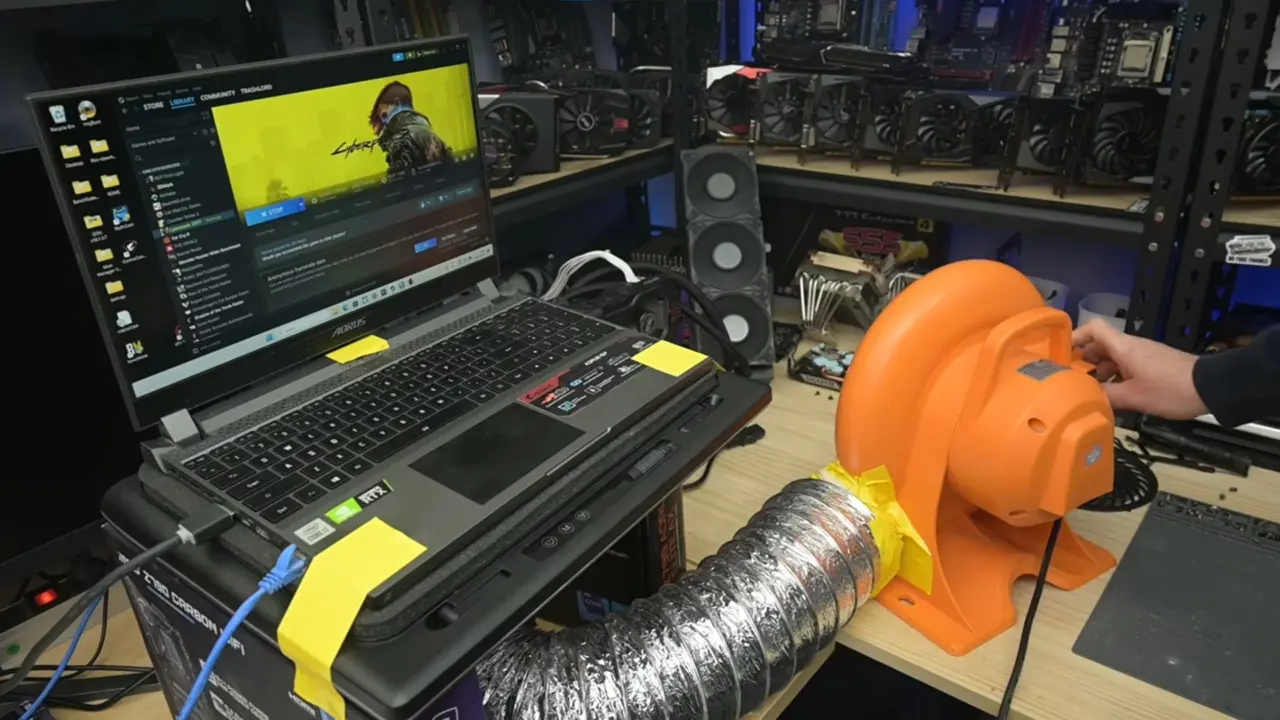
We took it to the extreme with cooling tests on a gaming laptop to see if the flow of air can outperform the conventional cooling approach. A modder named Trash Bench utilized a blower from a bounce house to cool a non opened up laptop chassis. This helps to illustrate how the thermal limits of our devices can be a primary bottleneck for performance on thin gaming systems. Readers who experience heat issues with their laptops may be able to take some information away from this experiment and apply it to their own devices.
Extreme airflow eliminates thermal bottleneck for 19% gaming boost
The device in question was equipped with an Intel Core i7 10750H CPU and an NVIDIA GeForce RTX 2070 Max-Q GPU. The GPU had a 90W power limit and was running at its stock thermal of 84 degrees Celsius. Trash Bench secured the laptop to the desk with tape in order to prevent any air leaks due to the force of the blower. This helped to isolate the cooling method from other factors like case adjustments or fan replacements.
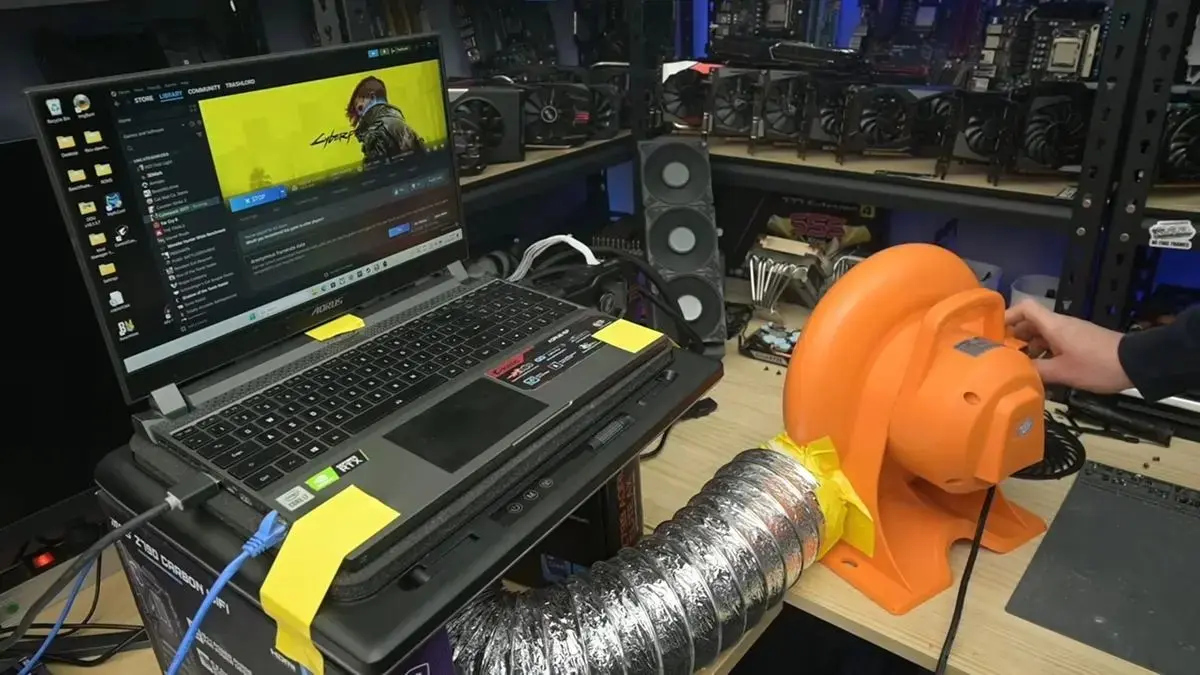
By using the bounce house blower they were able to bring the GPU average temperature down to 48.8 degrees Celsius. This is a decrease of 35.2 degrees Celsius from the stock thermal conditions. The extreme flow of air eliminated the thermal bottleneck that was holding things back before. Trash Bench mentions how the pressure was so intense that the device needed to be held in place.
When using the blower the increase from 47 FPS to 56 FPS in Cyberpunk was observed. There is a 19% gaming improvement from what was being achieved at stock conditions. As Trash Bench mentions, as the temperatures are reduced there is a diminishing returns situation that occurs after the thermal bottleneck is overcome. A different type of bottleneck emerges that restricts further improvement in performance.
This experiment helped to demonstrate how much you can benefit from extreme external air flow in order to reduce temperatures on your laptop. The 35-degree temperature decrease helps to show how much the thermal limitations are a key bottleneck for this type of hardware. We seem to be running up against a limit on improvement as far as performance is concerned after the thermal hurdle is overcome via our cooling solution. The real limitations of the current cooling approach for laptops are exposed.


Comments (0)