
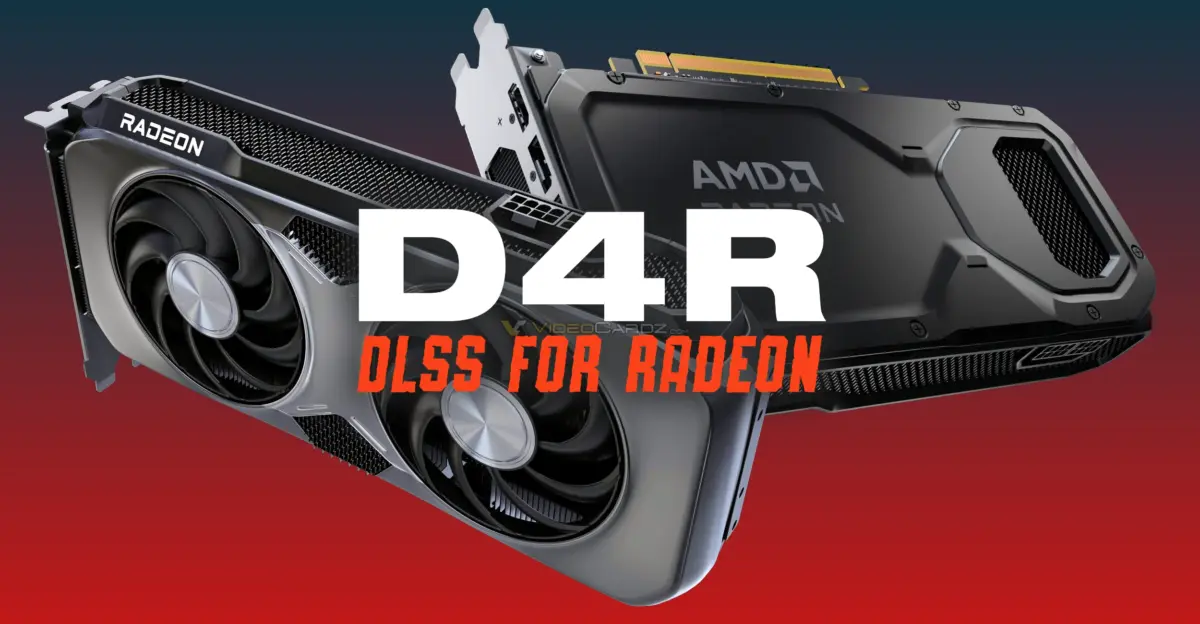
Modder Countervolts has updated the d4r project to bring NVIDIA's DLSS 3, 4, and 4.5 Super Resolution upscaling to AMD Radeon GPUs. This update matters because it allows Linux gamers using Proton to access NVIDIA's latest image quality models on hardware that does not natively support them. Users with RDNA 4 cards can now leverage these upscaling features in DirectX 12 titles without waiting for official AMD drivers.
RDNA 4 support utilizes native FP8 matrix operations
The d4r 0.1.2 release adds native support for the AMD RDNA 4 architecture, specifically targeting the gfx1201 and gfx1200 GPU families. The tool operates by combining NVIDIA's official nvngx_dlss.dll with ZLUDA and ROCm to translate the required instructions. This architecture allows the software to utilize the RDNA 4 chip's native FP8 matrix operations, which are enabled by default for better efficiency.
- Supported DLSS Versions: DLSS 3, DLSS 4, DLSS 4.5
- Supported GPU Architecture: AMD RDNA 4 (gfx1201, gfx1200)
- Native Feature: FP8 Matrix Operations
- Underlying Technology: ZLUDA, ROCm, Custom Radeon Kernels
- Limitations: Super Resolution only; No Frame Generation, Ray Reconstruction, or DLSS 5
Performance on current RDNA 3 hardware provides a baseline for what users might expect from the new RDNA 4 support. Tests on an RX 7700 XT showed DLSS 4.5 achieving 49.3 FPS in Silent Hill Townfall at 1440p Quality, a slight improvement over the previous 48.4 FPS. The developer notes that this performance level remains below AMD's FSR4, suggesting that RDNA 3 users may still prefer the native alternative for now.
The project currently supports only Super Resolution and does not include Frame Generation, Ray Reconstruction, or DLSS 5 Neural Rendering. RDNA 4 performance and image quality results are not yet verified on physical hardware, as the developer has only tested the gfx1201 path through emulation. The gfx1200 builds have been compiled but lack published performance data from a physical card.
We have seen similar efforts to run NVIDIA technologies on AMD hardware, such as the recent coverage of CUDA-for-AMD-Windows on the RX 9060 XT. When we covered the last d4r update, several of the same balance and stability themes came up. This latest release continues the trend of community-driven compatibility layers bridging the gap between competing GPU ecosystems.
The d4r project remains a software modification that enables specific upscaling models on unsupported hardware. Users interested in testing DLSS 4.5 on RDNA 4 should be aware that official performance benchmarks are not yet available. The tool provides access to NVIDIA's Super Resolution technology but does not replace the full feature set of native drivers.


Discussion
0 comments
Log in to join the thread with a thoughtful take, question, or correction.