
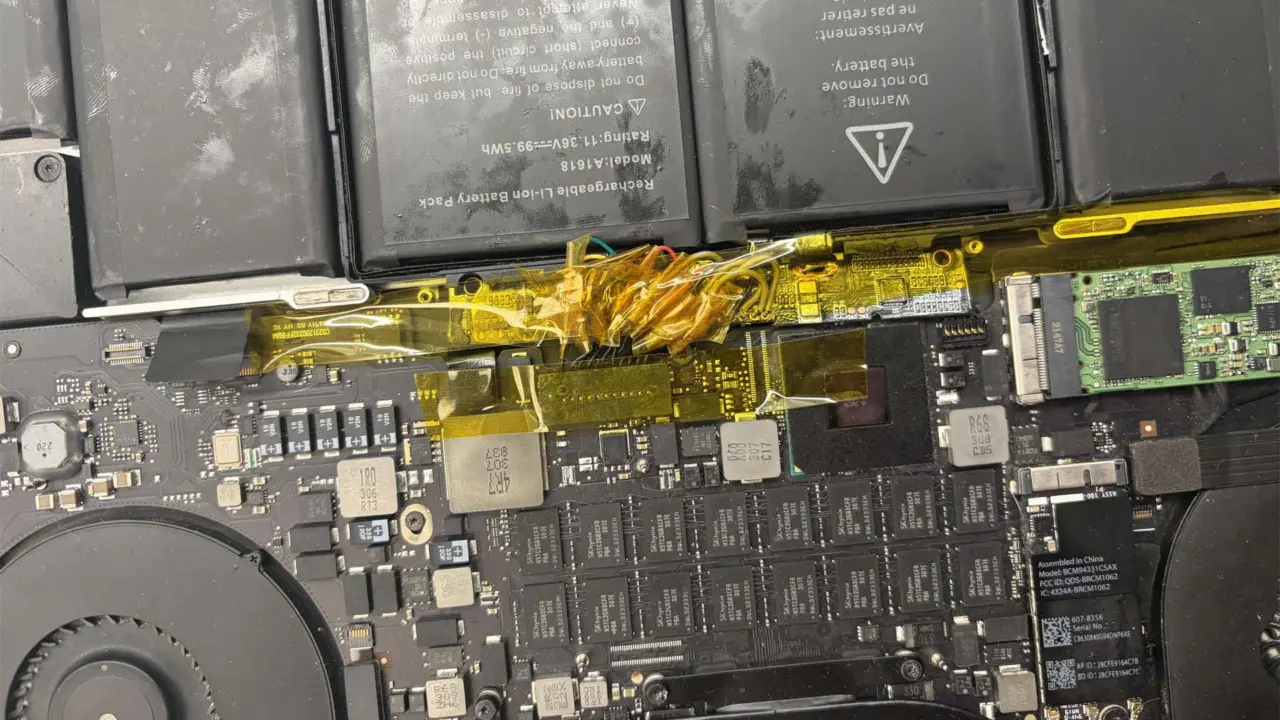
A MacBook owner recently modified a laptop battery installation in a way that works but creates a serious safety risk. The user replaced the required A1417 battery with an incompatible A1618 unit and used jumper cables to make it function. This modification highlights the dangers of bypassing manufacturer safety protocols and using improper insulation for high-current components. Readers should note that while the device operates, the setup poses a potential fire hazard that could damage the machine or cause injury.
Hand-soldered wires and sealed adhesive create a ticking time bomb
The core of the issue involves the mismatch between the installed A1618 battery and the MacBook logic board designed for an A1417 model. To bridge this gap, the owner hand-soldered copper wires to extend the Battery Management System (BMS) contacts. This manual wiring bypasses the standard connector interface, creating exposed conductive paths that rely entirely on the user's soldering quality and insulation choices. The solution allows the laptop to power on and run, but it removes the hardware-level safeguards built into the original design.
- Battery Model (Incorrect): A1618
- Battery Model (Required): A1417
- Storage Upgrade: M.2 NVMe SSD
- Adhesive Used: T-8000
Technical details of the mod reveal significant engineering shortcuts that compromise long-term reliability. The user secured the back panel using T-8000 adhesive instead of the original fastening method, which permanently seals the internal components. This adhesive choice prevents future inspection of the wiring and insulation, making it impossible to verify if the Kapton tape remains intact. The lack of proper thermal management access and the inability to monitor the soldered joints create a ticking time bomb scenario where a short circuit could ignite nearby materials.
The article title explicitly warns that this incorrect battery replacement results in a solution that is a potential fire hazard. We confirm that the modded battery poses a significant risk due to improper insulation and the inability to inspect the wiring over time. The direct quote from the source emphasizes that the jumper cable method works but is not safe for sustained use. Users attempting similar repairs should avoid this approach and stick to compatible parts with proper connectors to ensure safety and device integrity.


Discussion
0 comments
Log in to join the thread with a thoughtful take, question, or correction.