
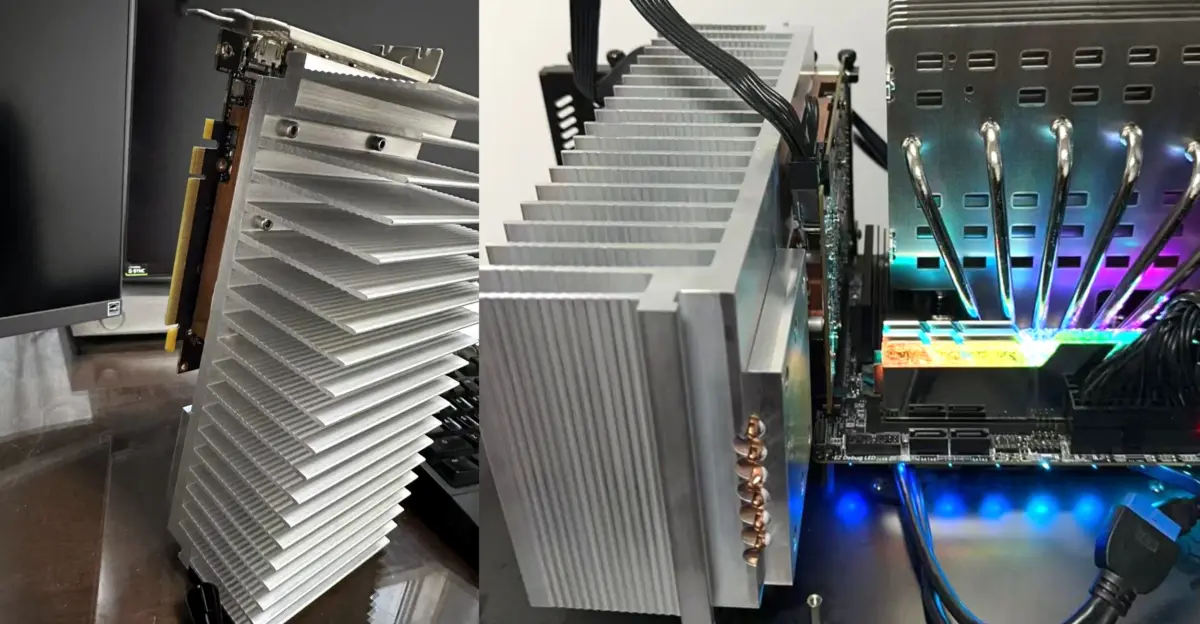
A custom-built fanless GeForce RTX 4060 proves that modern GPUs can run without fans when paired with enough aluminum. This modification demonstrates that mid-range graphics cards can operate effectively without the heavy, noisy cooling systems typically required by the industry. Buyers interested in silent builds now have a concrete example of what is technically possible with passive cooling.
Custom passive cooling project demonstrates silent GPU viability
The project uses an NVIDIA GeForce RTX 4060 graphics card as its core component. A PC builder attached a massive 2.5 kg block of extruded aluminum fins directly to the GPU. This design eliminates the need for any active cooling fans or moving parts.
Specifications
- Heatsink Weight: 2.5 kg
- Heatsink Material: Extruded aluminum
- Cooling Method: Passive / Fanless
- TGP: 115W
The card operates with a total graphics power (TGP) of 115W. This relatively low power draw makes the RTX 4060 one of the more suitable modern GPUs for passive cooling projects. The heatsink relies entirely on natural convection through large gaps between the fins to dissipate heat.
The sheer weight of the 2.5 kg aluminum block requires specific mounting considerations. Builders must use an open test bench or a vertical GPU mount to support the heavy cooler. Fanless graphics cards are becoming rare due to higher power limits and the impractical size of required heatsinks.
According to the source, this custom build shows that a current-generation GPU can operate without active cooling when paired with enough aluminum. The thermal performance under heavy load remains unquantified in the available reports. This project serves as a proof-of-concept for extreme silent computing rather than a commercially available product.

Discussion
0 comments
Log in to join the thread with a thoughtful take, question, or correction.