
Server administrators running AMD EPYC processors with SEV-SNP security features face a specific performance penalty when the CPU verifies memory integrity. This overhead can slow down virtual machine workloads, particularly those using large memory blocks. A new instruction set called RMPOPT addresses this bottleneck by skipping unnecessary checks for safe memory regions. This optimization matters because it allows cloud providers and enterprise users to maintain strong security without sacrificing compute throughput.

New instruction set reduces overhead for secure virtualization
The feature is part of AMD's upcoming Zen 6 microarchitecture, internally known as Venice. It targets the Reverse Map Page (RMP) checks that Secure Encrypted Virtualization – Secure Nested Paging (SEV-SNP) uses to validate memory pages. By introducing RMPOPT, AMD aims to significantly reduce the performance loss associated with these security validations. The instruction set is designed to work specifically with 1GB large memory regions that do not contain any SEV-SNP guests.
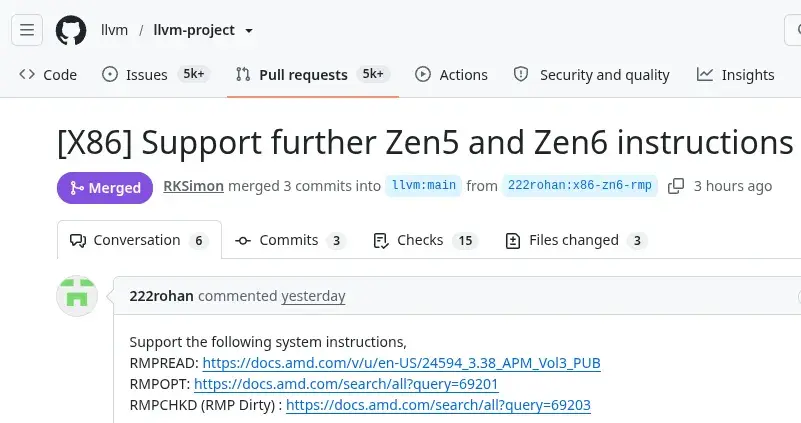
Support for this hardware feature is already appearing in software development tools. The LLVM/Clang compiler team has merged support for the RMPOPT instruction and the Zen 6 (znver6) microarchitecture identifier into their codebase. This integration allows developers to generate optimized code for the upcoming processors. Linux kernel support for RMPOPT was also submitted by AMD earlier this year, ensuring the operating system can utilize the new instruction.
Both the current Zen 5 and the upcoming Zen 6 microarchitectures will support the RMPOPT instruction. This backward compatibility ensures that the performance benefits extend to existing server fleets as they migrate to newer hardware. The optimization specifically skips RMP checks for memory regions known to be free of SEV-SNP guests, reducing latency for Virtual Machine Monitors and non-SNP guests. While the exact release date for Zen 6 Venice processors remains unconfirmed, the compiler support signals that the architecture is nearing finalization.
We looked at the last Zen 6 update earlier while tracking AMD's server roadmap changes. The integration of RMPOPT into LLVM/Clang marks a concrete step toward enabling this security optimization in production environments. Server operators can expect reduced overhead for SEV-SNP workloads once the hardware ships and the software stack is updated.


Discussion
0 comments
Log in to join the thread with a thoughtful take, question, or correction.