
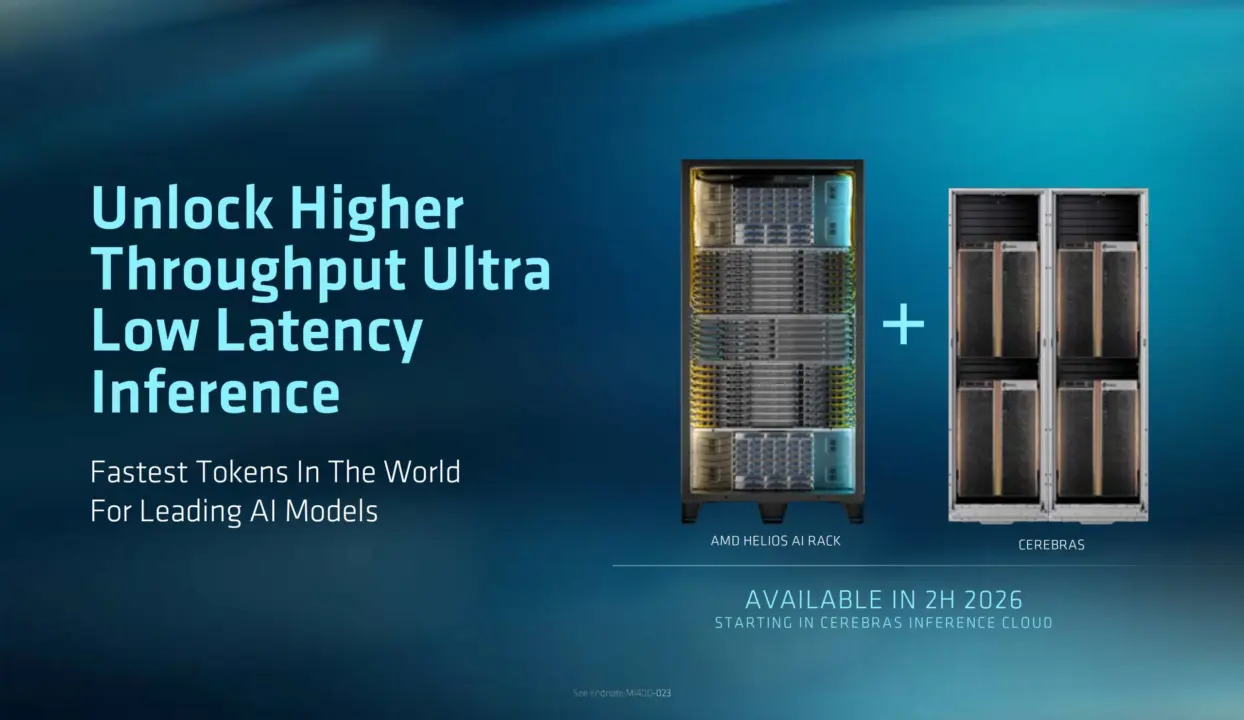
The AI hardware race just got a new contender with AMD’s Helios system, which aims to disrupt the current market by offering significantly better efficiency than NVIDIA’s latest rack-scale offering. This partnership between AMD and Cerebras introduces a hybrid architecture that combines high throughput with ultra-low latency, directly addressing the needs of developers building complex coding and agentic AI applications. Buyers and enterprises monitoring inference costs will find this integration relevant as it promises to deliver five times more tokens per second per watt compared to NVIDIA’s competing Groq-based solution.
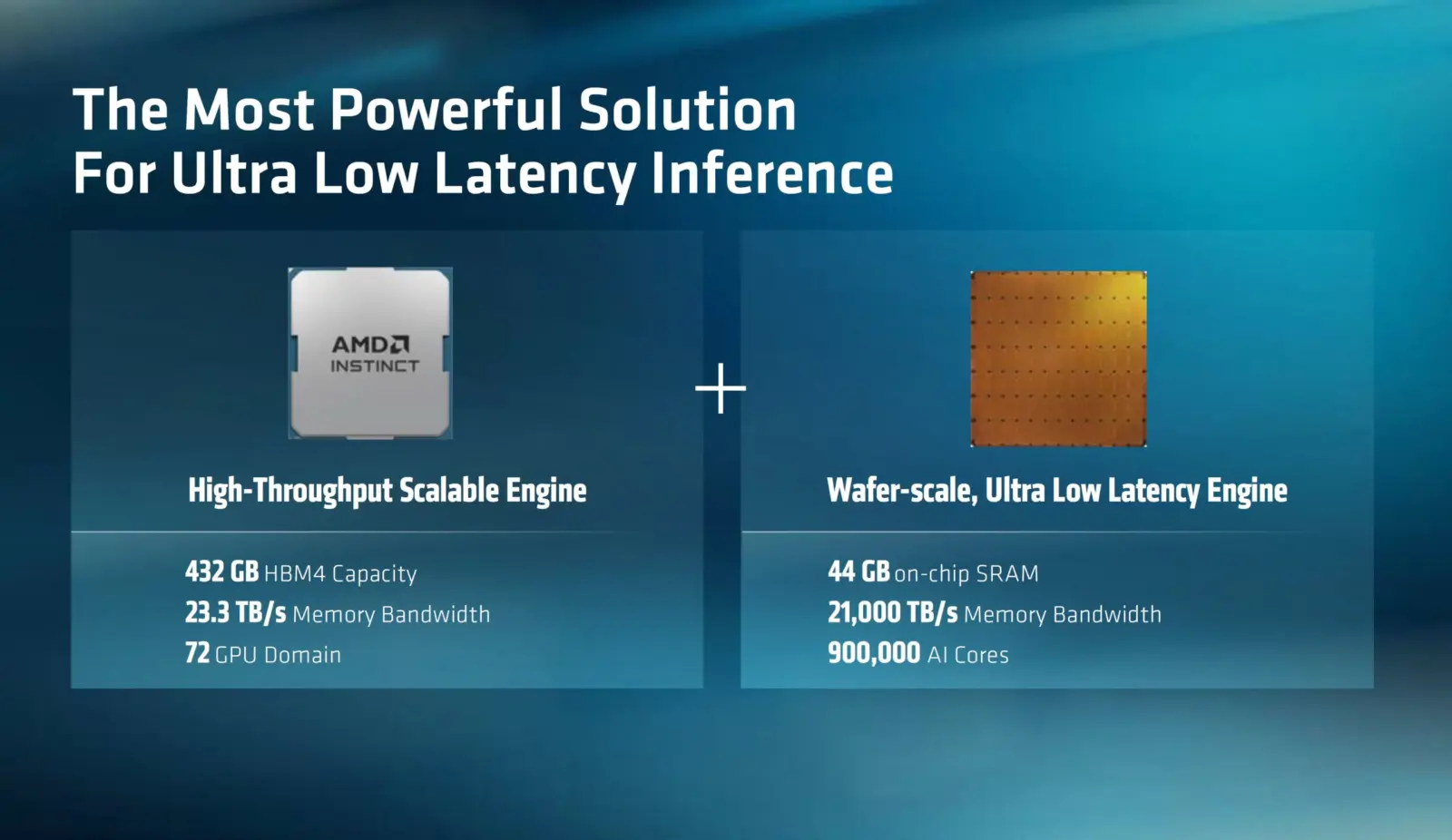
Hybrid architecture targets 5x tokens per watt gain over NVIDIA Groq 3 LPX
Helios represents a strategic fusion of AMD’s compute infrastructure and Cerebras’ Wafer-Scale Engine technology, designed to create a versatile alternative to rigid single-architecture systems. While NVIDIA relies on interconnected LPU accelerators for its Groq 3 LPX rack, the AMD-Cerebras approach merges two distinct compute engines to handle both volume-based workloads and latency-sensitive tasks. This dual-engine design allows the system to maintain high throughput while providing the ultra-fast decode capabilities required for advanced AI generation tasks.
The technical core of this announcement rests on the integration of Cerebras’ Wafer-Scale Engine with AMD’s processing power to achieve specific performance targets. AMD states that this combination is expected to deliver up to 5x higher tokens per second per watt when compared to NVIDIA’s Groq 3 LPX configuration. The NVIDIA competitor spec involves a rack featuring 256 interconnected Groq 3 LPU accelerators with full liquid cooling and 315 PFLOPS of inference power, a benchmark the new AMD-Cerebras system aims to surpass in efficiency.
This architecture targets specific use cases where both speed and energy efficiency are critical, particularly for coding assistants and autonomous agents that require immediate responses. The system is described as more versatile than NVIDIA’s rigid LPU architecture, allowing it to adapt to varying workload demands without sacrificing performance. By focusing on ultra-low latency for decode and token generation, the Helios solution positions itself as a specialized engine for next-generation AI applications that demand both scale and responsiveness.


Discussion
0 comments
Log in to join the thread with a thoughtful take, question, or correction.