
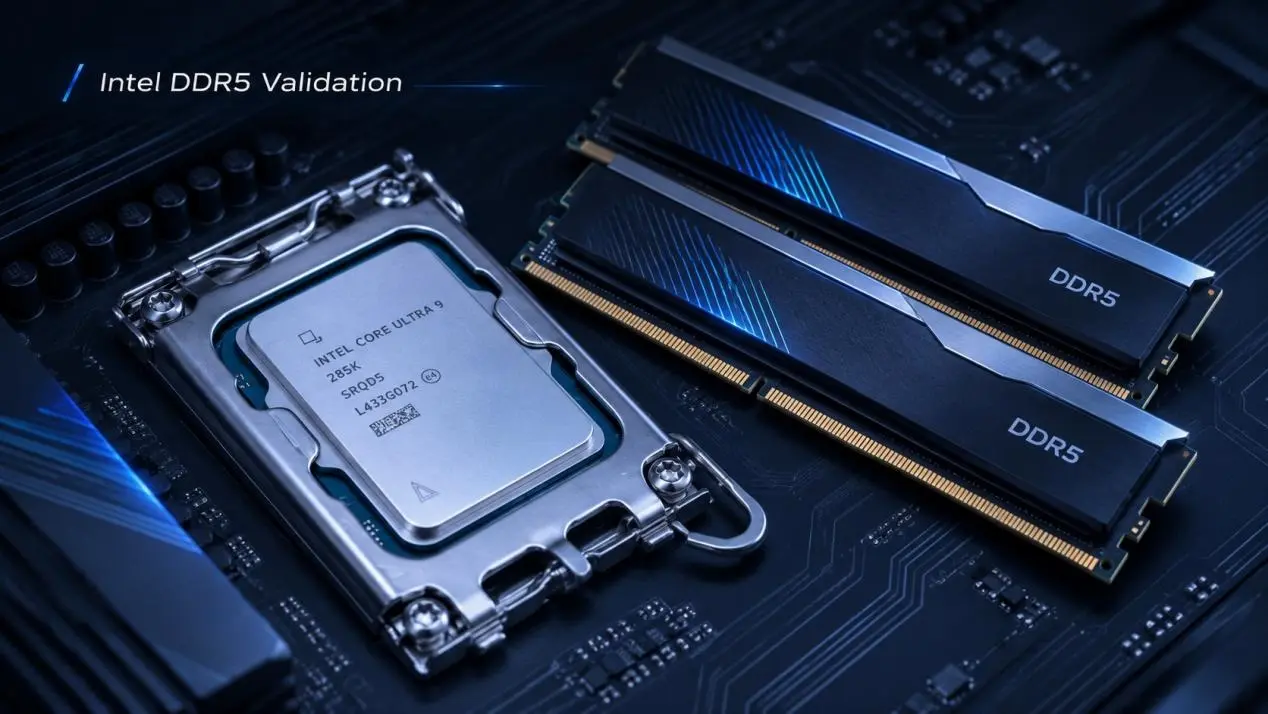
Intel revealed the early struggles behind the development of DDR5 memory. The first prototypes were so unreliable that you could plug them in and they wouldn't even work. This highlights the sheer complexity of engineering involved in making DDR5 a stable standard. If you're someone who cares about system stability or memory reliability, this is some great insight into the current state of DDR5 modules.
Intel details DDR5 R&D struggles and Quad Rank capacity gains
The design of DDR5 involves the inclusion of Power Management ICs right on the memory module. This means that the complexity of the circuitry increases by having the power management IC on-board. It requires tighter electrical margins than previous generations. Intel works with Samsung, SK Hynix, Micron and JEDEC to make sure these complex memory modules work together with processors, without compatibility problems.
Specifications
- Power Management IC Integration: Integrated directly on the memory module
- Single Stick Capacity: 128GB
- Total Capacity (2-slot ITX): 256GB
- Memory Density Evolution: From 16Gb (2GB) in Alder Lake to 32Gb (4GB) in Arrow Lake
- Reference Code Optimization: Firmware for automatic calibration of memory frequency and voltage during system boot
Intel is pushing Quad Rank memory to make 128GB sticks possible. This makes 256GB (2-slot) on ITX boards possible. That's a key factor for small form factors.
The memory density has doubled. It was 16Gb (2GB) for Alder Lake, now its 32Gb (4GB) for Arrow Lake. That makes high density possible.
ASRock / Kingston has shown off a 256GB at 7400MT/s on a Z890I Nova. For more, Intel is also optimizing firmware to automatically calibrate memory frequency, voltage at system boot time. Gabe Gelfand, Senior Memory Technology Project Manager @ Intel says that early failures are part of the R&D process.
Our previous Intel coverage touched on Biostar brings Intel Panther Lake-H to. Right now, they're working on making high-density memories stable like 128GB sticks for various types of platforms. They're also iterating on reference code to make sure they work well for various types of motherboards.


Power Management IC integration changes the electrical landscape entirely. Tighter margins mean early prototypes failing to initialize is expected engineering friction.