
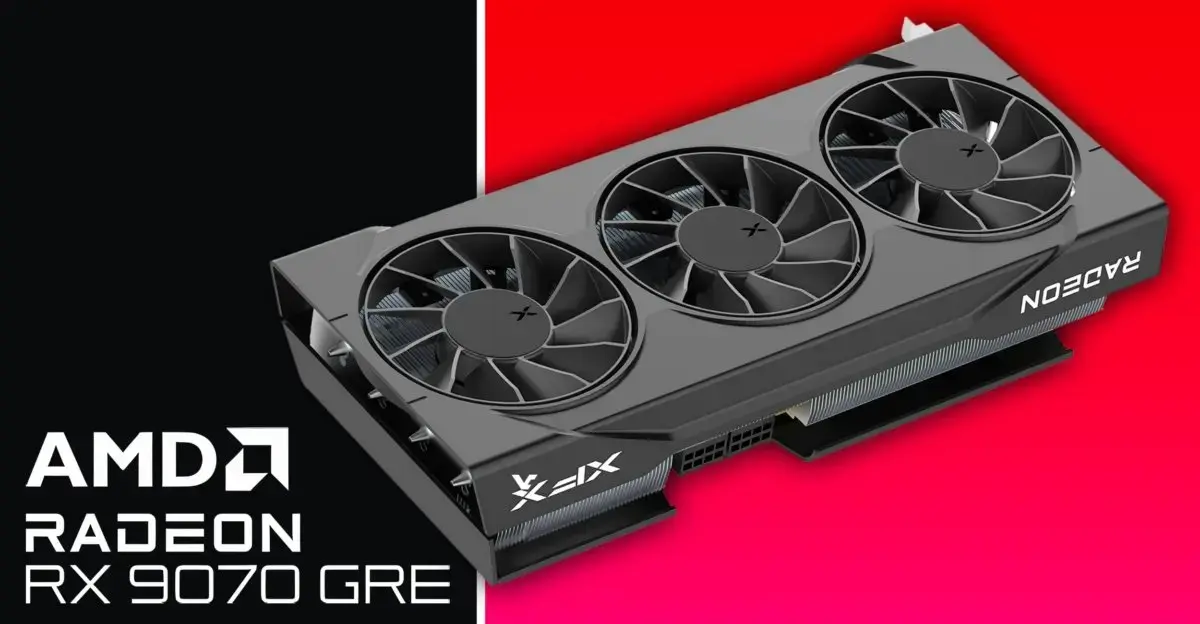
In one of our hardware tests, we have observed how the AMD Radeon RX 9070 GRE exceeding the factory speeds. It's significant since it reveals how much room for tweaking is available with the latest RDNA4 architecture. This gives insight into the potential for extreme performance enthusiasts who want to know how far they can go without necessarily getting a pricier card.
Overclocker achieves record clock speed on stock hardware using lightweight workload
The new world record comes courtesy of the overclocker known as ShrimpBrine on an XFX Radeon RX 9070 GRE Swift. For this attempt, the test workload was the lightweight DirectX 9 GPU Frequency Generator. Specifically, this software is designed to render a very basic scene with a draw call consisting of 2,048 triangles. The idea is to really stress the clock speeds.
- Boost Clock: 3.9 GHz
- Official Boost Clock: 2.79 GHz
- Power Consumption: 130W
- Workload Type: Custom DirectX 9
- Architecture: RDNA4
The GPU was able to hit 3.9 GHz in boost clock speeds. This is roughly a 40% increase from the official AMD boost speeds of 2.79 GHz. The test setup used roughly 130W of power to achieve those higher speeds. All of this was achieved on stock hardware using R-Team OC utility software.
For this test, the stock cooling solution was used. Plus, the VBIOS was also stock. So no hardware mods were needed to hit those higher clocks.
But the graphics driver did crash and then quickly recover after the record was logged. This does indicate it's not a stable record for gaming use in daily operations.
We've been following the Radeon RX 9070 GRE pretty closely. Check out our coverage on the AMD Radeon RX 9070 GRE Price. In particular, we've just recently seen the Radeon RX 9070 GRE break below $500 on Newegg.
So it's pretty affordable for budget builders. But while this overclocking does highlight the silicon potential, it doesn't change the end user experience.
Still, it's a very impressive feat in highlighting the raw potential of RDNA4 silicon in perfect conditions. And this can be used as a benchmark for those who enjoy pushing hardware to the limit. But for average users, you'll see the official boost clock speeds at 2.79 GHz in most gaming use cases.


Does the 3.9 GHz figure hold up under actual game loads or just that lightweight DirectX 9 generator? I need real numbers before I care.
It is unlikely to sustain that in a heavy game. The driver crashed during the test which indicates the voltage was pushed beyond the stability margin for complex workloads. RDNA4 might have headroom but it is not magic.
driver crashing is not a feature 😅
The article states the official boost is 2.79 GHz. A jump to 3.9 GHz is significant but only under a specific triangle count workload. It does not reflect typical gaming performance.
I am more concerned about the price of VRAM right now. If this card drops below five hundred dollars it might actually be worth buying for a budget build.
Overclocking records on stock cooling are impressive for the silicon quality. It shows AMD has good binning on the RDNA4 chips even if the clocks are not useful for daily gaming.
I suspect this is just a quirk of the specific VBIOS on the XFX Swift model. Other partners might not see the same results with the same voltage limits.
130W for 3.9 GHz is efficient. My old card used way more power for half that speed. The RDNA4 architecture is definitely a step forward in efficiency.
As long as the price stays under five hundred dollars I will ignore the overclocks. RAM prices are killing my budget anyway.
The driver recovery is the key detail here. It proves the GPU did not die but the system was unstable. This is a benchmark not a stable configuration.
DirectX 9 workload is a weird choice for a modern GPU review.