
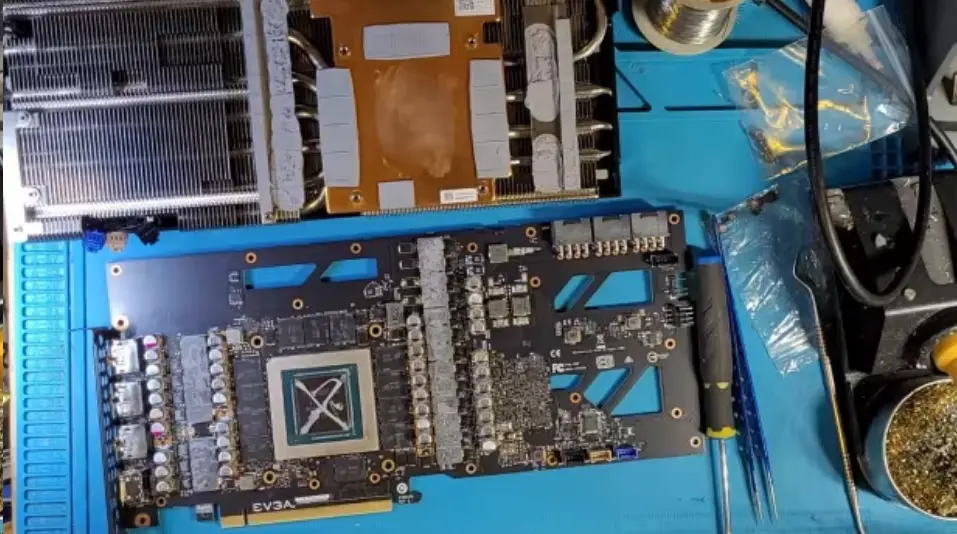
NVIDIA RTX 3080 owners pushing their cards to full power face serious heat issues in the memory modules. Stock thermal pads alone fail to keep the GDDR6X chips within safe limits during heavy workloads. Managing VRAM temperatures is critical because excessive heat can reduce performance and potentially shorten the lifespan of high-end graphics cards. The test evaluated a modification combining thermal paste with pads to determine its effectiveness in lowering temperatures.
Hybrid cooling mod tames 95C memory temps on 450W load
The test focused on an EVGA-branded RTX 3080 running at a 450W load. Under these conditions, the stock thermal pads allowed the VRAM temperature to exceed 95 degrees Celsius. The GPU core itself remained stable at approximately 70 degrees Celsius, indicating the bottleneck is strictly in the memory cooling. The distinct temperature profiles of the GPU core and VRAM help identify specific areas requiring targeted cooling.
Specifications
- GPU Core Temperature: Near 70°C
- Stock VRAM Temperature: Over 95°C
- Modified VRAM Temperature: Max 80°C
- Temperature Reduction: Approx 15°C
- Test Load: 450W
Blogger Blighted Agent recently tested applying both thermal paste and thermal pads to the GDDR6X VRAM modules of an RTX 3080, reducing VRAM temperatures by up to 15 degrees Celsius. The modified setup capped the hottest VRAM module at 80 degrees Celsius. This result proves that adding a conductive layer directly to the memory chips significantly improves heat transfer compared to using pads alone. We note that the specific GPU core thermal paste used in the mixed test was not clearly isolated in the primary result description.
Replacing only the stock pads with new ones did not match the temperature reduction achieved by the paste-and-pad combination. The standard pad replacement operation yielded results nearly identical to the initial stock configuration. The results indicate that standard thermal pads may not adequately bridge the gap between the memory modules and the cooler. Enthusiasts looking to optimize their RTX 3080 should consider this hybrid approach for the best thermal results.
We previously covered how an RTX 3070 saw a 24-degree drop after a similar thermal paste swap. The RTX 3080 modification offers a slightly smaller but still significant 15-degree improvement under extreme load. The data supports the use of direct thermal paste application as an effective method for managing VRAM heat in Nvidia's Ampere architecture. Users with high-wattage RTX 3080 cards can now apply this technique to maintain lower operating temperatures.

Discussion
0 comments
Log in to join the thread with a thoughtful take, question, or correction.