
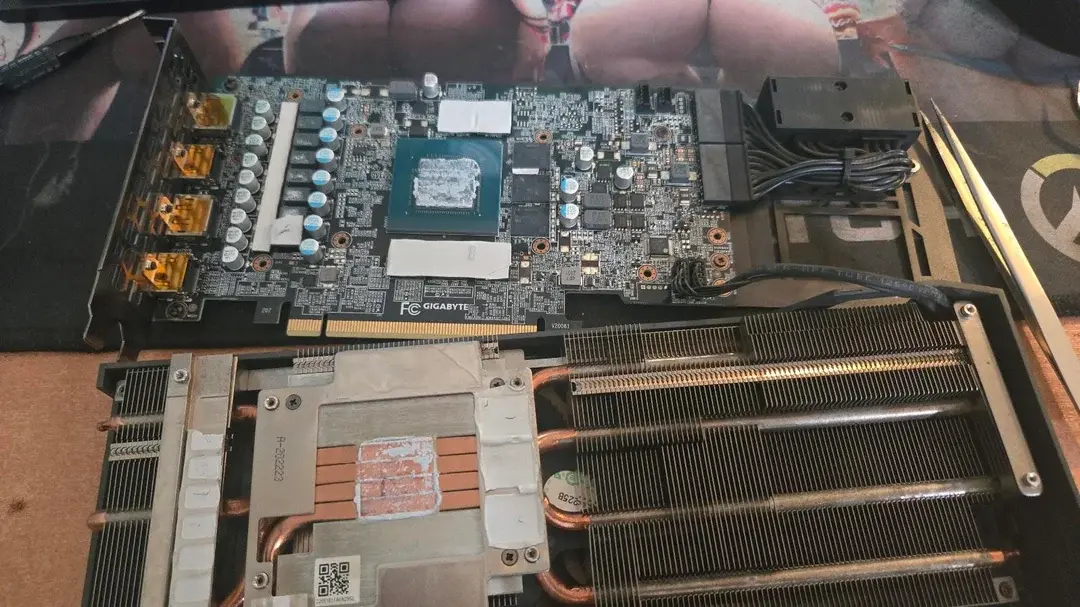
Degraded thermal paste is a silent killer for older graphics cards, often causing fans to scream and performance to throttle. A recent modification to a Gigabyte GeForce RTX 3070 Eagle OC V2 shows that swapping materials can restore factory-like cooling efficiency. This matters because many gamers hold onto older cards that have become noisy or unstable over time. Upgrading the thermal interface offers a practical way to extend the life of existing hardware without buying new components.
Phase-change pads restore factory cooling on aging hardware
The subject of this maintenance is the Gigabyte GeForce RTX 3070 Eagle OC V2. A Reddit user shared the results of replacing the original thermal compound with higher-performance alternatives. The goal was to address the excessive fan noise that occurred at 100% speed due to high operating temperatures. The modification targets both the GPU core and the surrounding memory modules to improve overall heat dissipation.
Thermal Improvements
- VRAM Temp Reduction: 24°C (99°C to 75°C)
- Core Temp Reduction: 13°C (85°C to 72°C)
- Hotspot Temp Reduction: 23°C (106°C to 83°C)
- Core-to-Hotspot Delta: 11°C (reduced from 21°C)
- Thermal Interface Material (Core): Thermalright PhaseSheet PTM
The user replaced the aged thermal paste with Thermalright PhaseSheet PTM on the GPU core. They applied Thermalright Putty Advance to the VRAM and power delivery modules. These materials are designed to fill microscopic gaps better than standard paste and eliminate the pump-out effect. The results were immediate and significant across all measured temperature points. VRAM temperatures dropped from 99°C to 75°C, a reduction of 24°C. The GPU core temperature fell from 85°C to 72°C, a 13°C improvement. The hotspot temperature also decreased from 106°C to 83°C, a 23°C drop. The temperature delta between the core and hotspot shrank from 21°C to 11°C.
The article analysis notes that phase-change pads provide superior thermal transfer compared to traditional pastes. The Reddit user reported that the fan noise became manageable after the temperatures stabilized. Testing was conducted while running Overwatch 2, though the source does not specify if other titles were benchmarked. This specific combination of materials appears to offer a reliable solution for cards suffering from thermal degradation. Gamers with similar aging hardware can expect comparable improvements by following this maintenance approach.
No pricing or availability information is provided for this modification, as it is a user-performed maintenance task. The story highlights a specific case study rather than a commercial product update. The key takeaway is that thermal interface material degrades over time and significantly impacts performance. Replacing it with high-quality phase-change pads and thermal putty can restore cooling efficiency and reduce noise levels.

Discussion
0 comments
Log in to join the thread with a thoughtful take, question, or correction.