
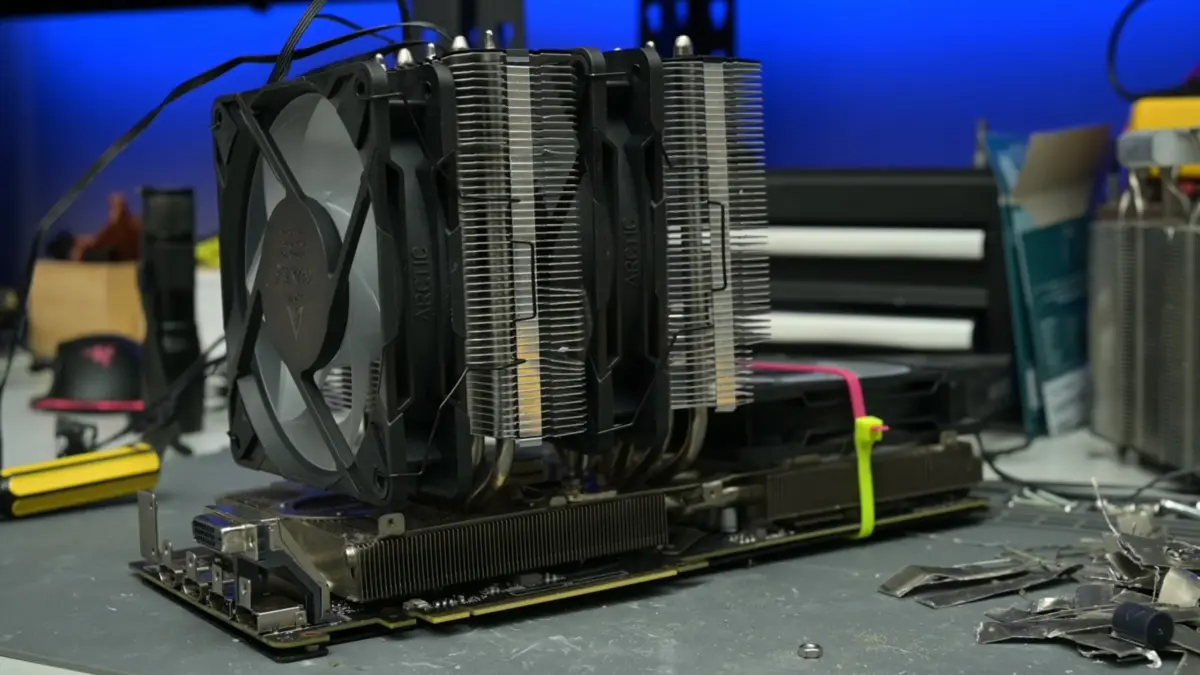
Users seeking improved stability and longevity often find that standard cooling solutions are insufficient for high-end graphics cards. A recent modification of the GeForce GTX 1080 Ti demonstrates how drastic thermal improvements are possible when users step outside factory designs. This modification demonstrates that manual cooling upgrades can enhance thermal performance and efficiency without requiring new hardware purchases.
Modder TrashBench grinds heatsink to fit dual-tower
The subject of this experiment is the NVIDIA GeForce GTX 1080 Ti, a high-performance graphics card that typically runs hot under load. Modder TrashBench replaced the card's stock cooler with a large dual-tower CPU cooler to achieve better heat dissipation. This process required grinding away the original heatsink fins to make the larger cooler fit physically onto the GPU die. The modification addresses the thermal limitations inherent in the dense design of the graphics card.
The modification resulted in a substantial reduction in operating temperatures. The factory cooler maintained the GPU at 56°C in an environment with an ambient temperature of 15°C. After installing the dual-tower CPU cooler, the temperature dropped to 32°C, a reduction of 24°C. This lower thermal headroom allowed the card to maintain higher sustained clock speeds while pulling approximately 300W of power. The modder also noted that power consumption decreased slightly during testing, though an attempt to overclock the GPU to 2200 MHz proved unstable.
This type of modification is not unique to the GTX 1080 Ti, as similar mods have been performed on GTX 1060, GTX 1070, and RTX 20 series cards. This process involves permanent physical alteration of the graphics card and typically voids the manufacturer warranty. We've been tracking GeForce GTX 1080 Ti closely — see our earlier coverage on Windows 11 April Update Crashes PCs. The experiment confirms that external cooling solutions can drastically alter the thermal profile of legacy high-end GPUs, offering a path for enthusiasts willing to perform the work.

Discussion
0 comments
Log in to join the thread with a thoughtful take, question, or correction.