
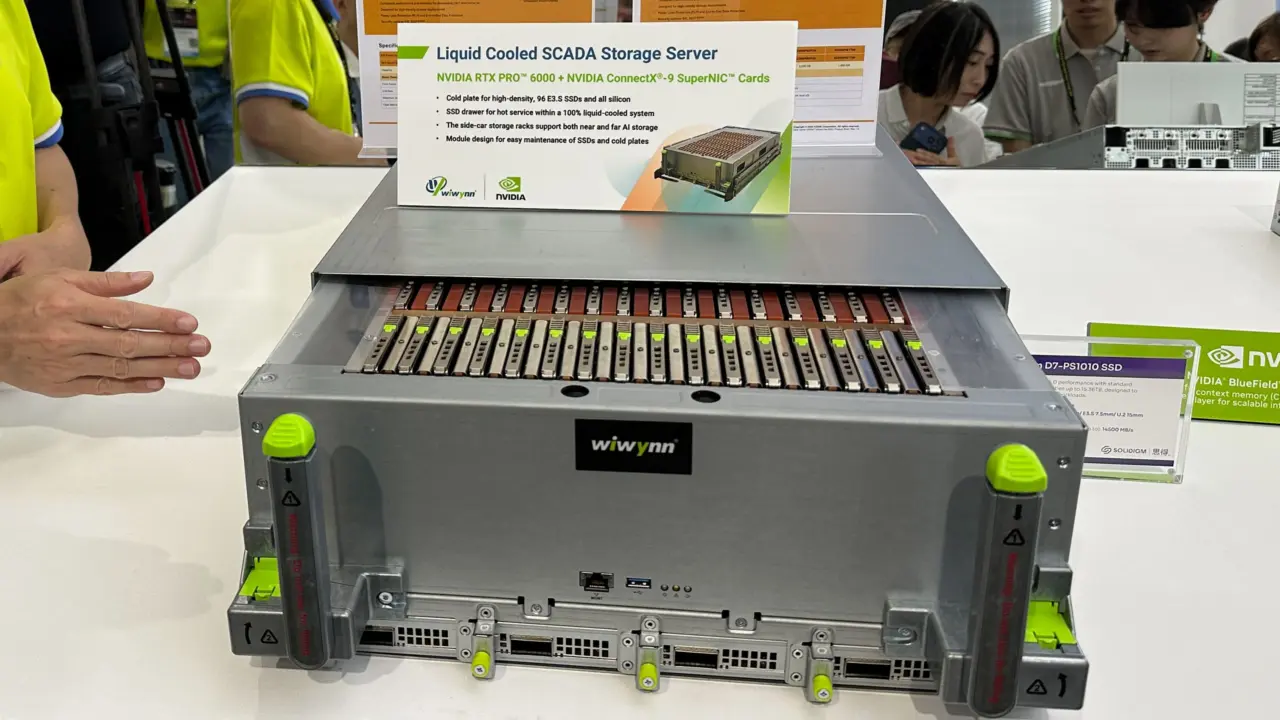
Wiwynn displayed a new data center server platform at Computex 2026 that aims to solve storage bottlenecks for AI workloads. The company calls the system SCADA, which stands for SCaled Accelerated Data Access. This architecture lets graphics processors handle storage tasks directly instead of relying on traditional CPUs.
Wiwynn unveils a liquid-cooled server platform featuring Nvidia Vera CPUs and four RTX Pro 6000 Blackwell GPUs to accelerate AI data access.
The machine runs on Nvidia Vera central processing units and mounts four RTX Pro 6000 Blackwell GPUs. It uses a massive array of up to ninety-six liquid-cooled E3.S solid-state drives for primary storage. The system connects everything through four PCIe 6.x switches and four ConnectX-9 SuperNIC cards.
Spec comparison
- Storage Capacity: Up to 2.949 PB (with 96x 30.72 TB Micron 9650 Pro E3.S SSDs)
- SSD Configuration: Up to 96 liquid-cooled E3.S SSDs (e.g., Micron 9650 Pro)
- GPU Configuration: Four RTX Pro 6000 Blackwell graphics cards
- CPU Platform: Nvidia Vera CPU
- Interconnect/Switches: Four PCIe 6.x switches and four ConnectX-9 SuperNIC cards
Wiwynn claims the server can store up to 2.949 petabytes when fitted with Micron 9650 Pro drives. Each drive holds 30.72 terabytes of data in this top configuration. The platform achieves an aggregated random read speed of 528 million 4K IOPS according to vendor specifications.
Sequential read and write speeds depend on the PCIe switches and network cards rather than the storage modules themselves. The entire system draws up to 9 kilowatts of power inside a 6RU chassis. All major components receive liquid cooling, including six separate cold plate modules for the drive bays.
Wiwynn does not list a specific price for the SCADA server because costs vary with component purchases and volume discounts. The vendor cites fluctuating prices for 3D NAND, DRAM, and SSDs as reasons for withholding pricing details. No official release date exists beyond the Computex 2026 showcase.
The SCADA architecture positions this hardware between fast tier 1 storage tiers and slower remote HDD arrays. It targets AI inference and training workloads that require massive parallel I/O operations without CPU interference. This design represents a shift toward GPU-driven data access in modern data centers.
Discussion
0 comments
Log in to join the thread with a thoughtful take, question, or correction.