

A Chinese hardware tinkerer has proven that a standard desktop PC can run entirely on disposable batteries, a feat that challenges our reliance on wall outlets for basic computing tasks. Uwoslab constructed a custom power system using 192 AA alkaline cells to keep an AM4 motherboard alive, demonstrating that off-the-shelf batteries can deliver stable voltage under heavy computational load. The project demonstrates that maintaining stable voltage levels can keep a system running even as the battery capacity decreases. The build demonstrates that a desktop computer can operate independently of a wall outlet when powered by a sufficient battery array.
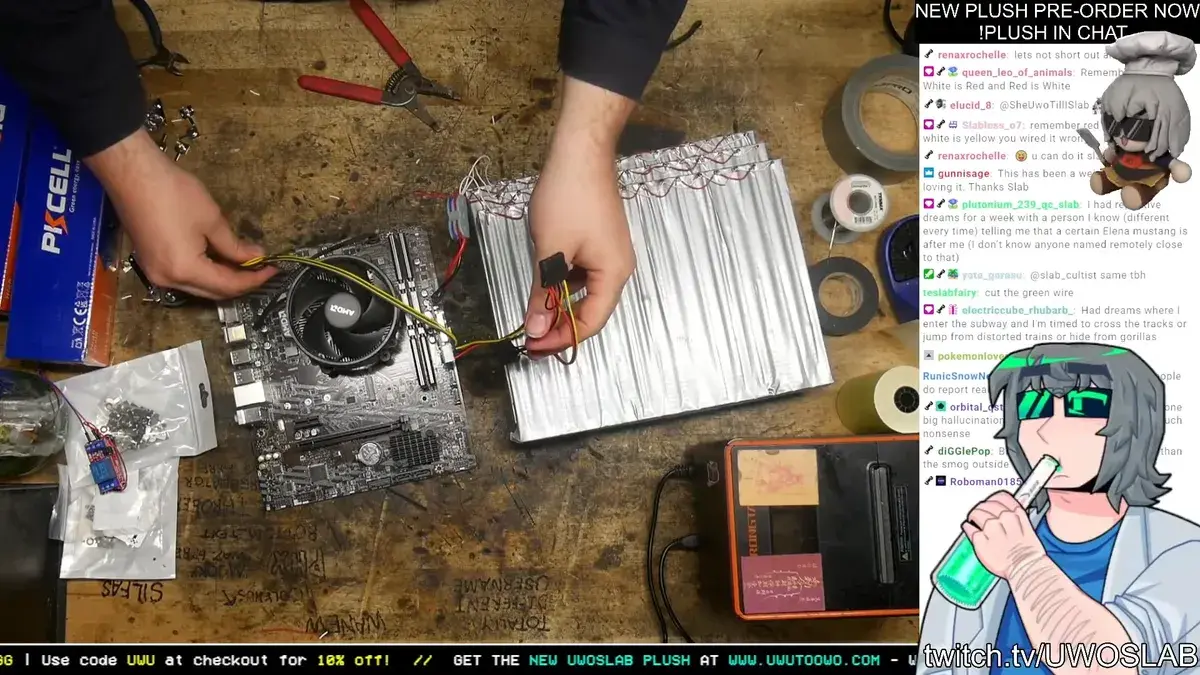
Uwoslab powers AM4 desktop with 192 AA batteries to boot Linux and pass stress tests
The core of this build is a standard AM4 socket motherboard paired with an AMD G-series processor that includes integrated Vega graphics. Uwoslab wired 192 AA alkaline batteries into a specific array to generate the 12V DC required by the PC's power supply. The configuration groups eight batteries in series to reach the target voltage and then connects 24 of these groups in parallel to provide sufficient current. The configuration uses a large battery bank to provide direct DC power to the motherboard, functioning similarly to an uninterruptible power supply.
Specifications
- Power Source: 192 AA alkaline batteries
- Motherboard Socket: AM4
- CPU: AMD G-series (Integrated Vega Graphics)
- Operating System: Hannah Montana Linux
- Stable Voltage Under Load: 11.95V
Technical measurements from the test reveal how the voltage behaves under stress. The system started with an initial voltage of 13V, which dropped to 11.95V as the batteries drained during operation. Despite this drop, the voltage remained stable enough to keep the system running without unexpected shutdowns. The CPU load reached 98% during stress-ng tests, proving that the battery array could sustain high power draws without collapsing. This stability is notable because previous attempts using 9V zinc-carbon batteries failed due to high internal resistance, which caused the voltage to sag too quickly.
The PC successfully booted into the Hannah Montana Linux distribution and passed the CPU stress tests without errors. After the stress test concluded, the system remained stable enough to launch and run the game FreeDoom. These results confirm that the battery array provided consistent power delivery throughout the entire workload. The test indicates that the hardware remained stable despite a voltage drop from 13V to 11.95V during operation. The system required 192 AA batteries to maintain operation under load.
We looked at Lenovo LOQ 15 Gaming Laptop Launches earlier while tracking Uwoslab launches. The experiment provides data on hardware resilience under battery power, though the setup is not intended as a practical power source. The build confirms that AM4 platforms can tolerate voltage fluctuations within a specific range. We can now verify that 192 AA alkaline cells are sufficient to boot and stress-test a standard desktop configuration. The test provides real-world performance data for the battery-powered configuration.



Discussion
0 comments
Log in to join the thread with a thoughtful take, question, or correction.