
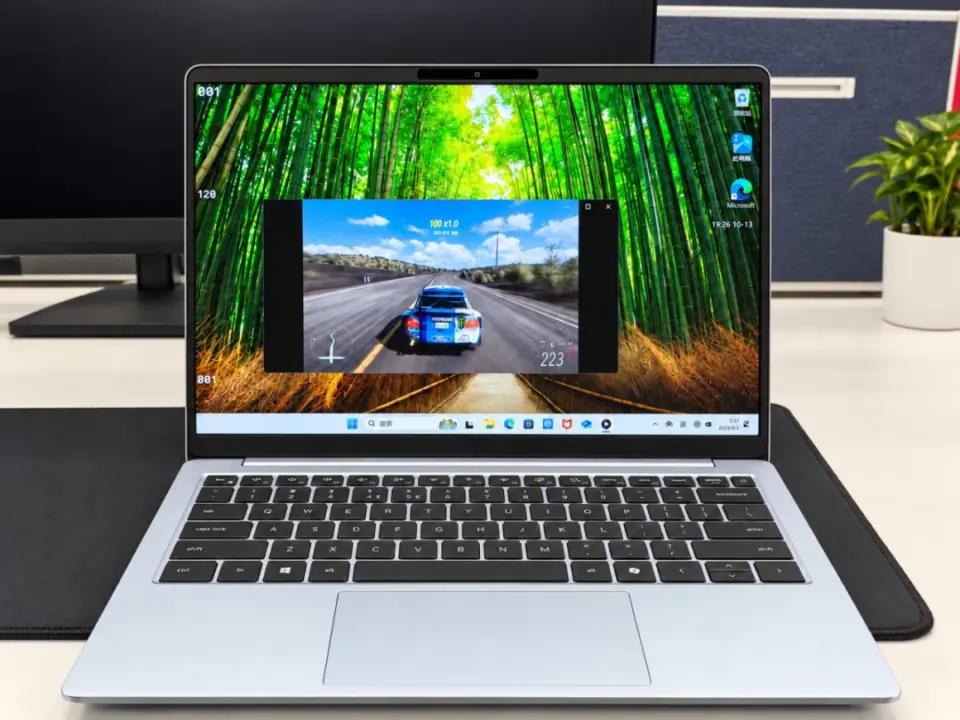
TIANMA announced a new 14" screen with split screen independent refresh zone solution. The purpose is to provide smooth refresh rate for moving content, extreme power saving for static content. It can be useful for people who want long battery for thin laptops doing mixed things.
TIANMA's new 14-inch WQXGA display splits the screen into three independent zones
The screen is 14" with WQXGA 2560×1600. It has 1Hz – 120Hz variable refresh rate. It uses oxide TFT backplane technology to efficiently handle the transition.
Specifications
- Size: 14 inches
- Resolution: WQXGA (2560×1600)
- Refresh Rate: 1Hz to 120Hz
- Technology: Oxide TFT backplane
- Feature: MFD (Multiple Frequency Display)
MFD technology is used to split screen horizontally into 3 distinct partitions. All of them can have different refresh rate at the same time. So if you are playing video in a window, that can have 120hz refresh rate. But if you have a static document window, it can be at 1hz.
When you are watching dynamic content like HD video, or playing light esports games. Full 120hz refresh rate will be used on that zone. When semi static scenes are presented, it smartly reduces refresh rate for power saving. When static content only, it will go for extreme power saving at ultra low 1hz refresh rate.
Oxide TFT backplanes have higher electron mobility, which helps with the transition speeds. But independent zone control usually adds significant overhead to the timing controller.
Does the oxide TFT technology actually solve the ghosting issues common in low refresh zones? I need independent numbers on pixel response time at 1Hz versus 120Hz.
The spec sheet mentions efficient handling of the transition, which implies improved gate driver integration. However, without a full datasheet, we cannot confirm if the 1Hz zone suffers from static image retention.
I suspect the power savings are negligible for most mixed workloads. You would need a very specific window arrangement to justify the complexity.
cool tech but i doubt my battery cares tbh