
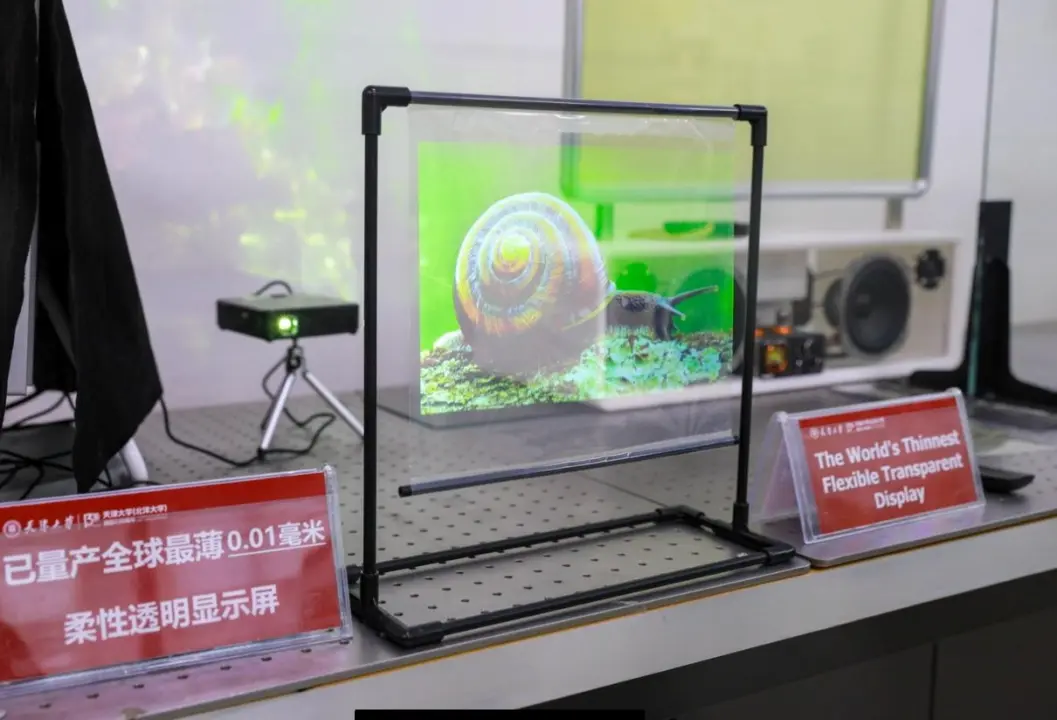
Just released by team from Tianjin University is this 0.01mm flexible transparent display. This is important because it gets rid of the bulky electronic backplanes on displays. What this technology does is make your display so that when it's off its essentially invisible. This technology opens up a world of possibility for AR and smart window type tech.
Photonic quantum technology enables zero standby power and 90% transparency
This is photonic quantum display technology based on optical excitation method. It can emit light directly without the electronic method. When on it is still self luminous.
Specifications
- Thickness: 0.01 mm
- Transparency: >90%
- Technology: Photonic quantum display
- Lifespan: Up to 30 years
- Manufacturing: Roll-to-roll printing
Yet in standby mode it requires zero energy. This is being commercially produced by Guangxin Liangxian (Tianjin) Technology Co., Ltd.
It is a roll-to-roll printing technique which employs organic-inorganic composite technology. It supports large scale production of up to 10,000 square meters. They say that despite its thickness, the display has ultra-high resolution.
Yet still transparent. It is more than 90% transparent. The display is also flexible.
This display lasts up to 30 years as per the developers. And is already in mass production and can be bought worldwide. The process of manufacture is stated as being ultra-low cost.
So this suggests they will be very accessible to the market. So if you're looking for next gen transparent interfaces, keep an eye on this tech.
Zero standby power is a bold claim. How do they handle refresh rates when the optical excitation needs to trigger? I am looking for actual timing specs before I believe the energy numbers.
The optical excitation method replaces the traditional electronic backplane entirely. It emits light directly without keeping a matrix powered up in standby. The zero energy claim relies on that passive state.
It is not just one of the thinnest. The source states it is one of the world’s thinnest flexible transparent displays at 0.01 mm. Be precise about the 90 percent transparency figure as well.
30 years lifespan on a roll-to-roll printed composite? I am skeptical about organic degradation under UV exposure over that duration.