
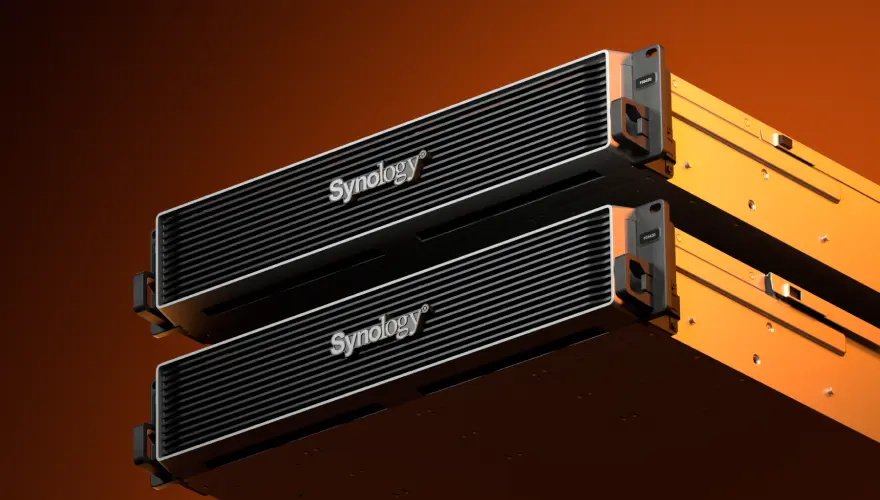
Synology announced the FS6420 and FS3420 on May 6. These new models join the company's portfolio of enterprise storage solutions. Both units are designed as 2U rackmount all-flash arrays. The company positioned these devices to handle high-performance workloads in data center environments.
Each model provides 24 drive bays for storage expansion. The FS6420 delivers 929K read IOPS and 257K write IOPS. This performance represents a 40 percent increase in read speed and a 26 percent increase in write speed compared to the previous generation. The FS3420 offers 478K read IOPS and 169K write IOPS. It achieves a 21 percent improvement in read performance and a 32 percent improvement in write performance over its predecessor.
Synology FS6420 and FS3420 Specifications
| Feature | FS6420 | FS3420 |
|---|---|---|
| Form Factor | 2U Rackmount | 2U Rackmount |
| Drive Bays | 24 | 24 |
| Read IOPS | 929K | 478K |
| Write IOPS | 257K | 169K |
| Standard Network | Dual 10GbE | Dual 10GbE |
Both arrays include dual 10GbE network interfaces as standard equipment. Users can add 25GbE or Fibre Channel expansion cards for higher bandwidth needs. Synology reports that SMB read throughput has increased by more than 60 percent. The hardware also features redundant power supplies and supports out-of-band management for reliable operation.
The announcement highlights Synology's focus on improving all-flash array efficiency. The company emphasizes significant gains in input/output operations and network throughput. These upgrades aim to support demanding enterprise applications that require consistent low-latency storage access.



Discussion
0 comments
Log in to join the thread with a thoughtful take, question, or correction.