
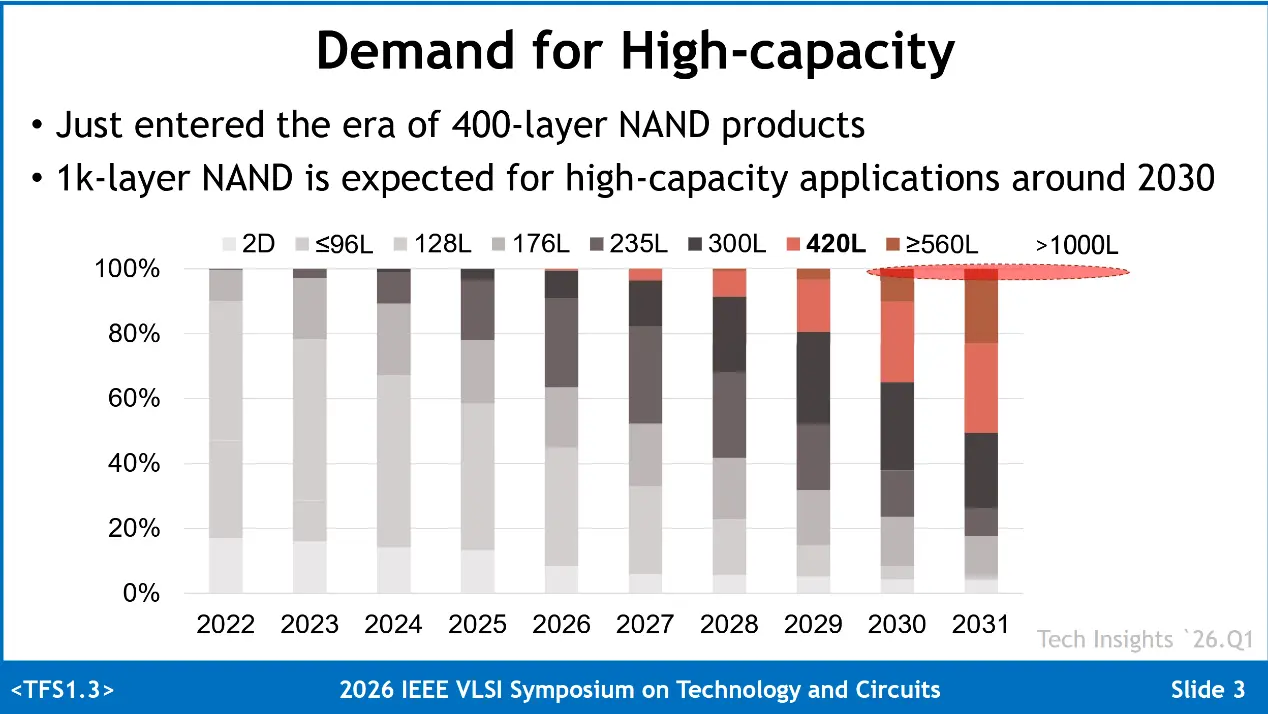
Samsung plans to dramatically increase the density of its NAND flash memory, moving from current mass production of over 300 layers to a near-term target of 400 layers this year. This push toward higher layer counts directly impacts the future capacity of solid-state drives, allowing for significantly larger storage volumes in both consumer and enterprise devices. The company aims to reach a milestone of 1000 layers by or after 2030, a timeline that suggests a gradual but steady evolution in storage technology rather than an immediate market shift. Industry observers note that this roadmap positions Samsung to compete with rivals like SK Hynix, which currently ships 321-layer 4D Flash products.
Samsung plans 400-layer Gen10 V-NAND mass production this year
Samsung recently demonstrated its capability to stack memory beyond the 300-layer barrier by announcing a 900-layer flash technology. This achievement relies on CMB (Chip Multi-Bonding) technology, which physically bonds two 450-layer NAND flash chips together to create a single, ultra-dense unit. This approach allows the company to bypass some of the physical limitations of single-stack manufacturing while preparing the groundwork for even higher layer counts in the future. The Gen10 V-NAND, which is slated for mass production within the year, represents the next step in this single-stack progression before the company fully commits to multi-chip bonding for its 1000-layer goals.
Samsung NAND Roadmap
- Current Mass Production Layer Count: 300+ layers
- SK Hynix Current Product: 321 layers (4D Flash)
- Samsung Near-Term Target: 400+ layers Gen10 V-NAND
- Samsung Recent Announcement: 900-layer stack (via CMB technology)
- Samsung Long-Term Target: 1000+ layers
The technical trajectory outlined by Samsung points toward a 1000-layer QLC NAND architecture that could enable consumer M.2 SSDs with 32TB of capacity. Such a drive would offer storage densities that were previously impossible with traditional hard disk drives, potentially reshaping how users manage large files and local data. For enterprise environments, the implications are even more significant, with projections indicating that storage capacities could reach the petabyte scale, or 1000TB, in the coming years. These capacity gains are driven by the increased density of QLC (Quad-Level Cell) NAND, which stores four bits of data per cell to maximize storage efficiency.
While the technical roadmap is clear, the source text warns that high-capacity SSDs may remain prohibitively expensive for average consumers if prices do not drop significantly. The source indicates that a 32TB SSD could become a luxury item with a sky-high price tag if manufacturing costs do not decrease alongside the increase in layer counts. This economic factor means that while the technology will likely dominate the enterprise and high-end enthusiast markets first, widespread consumer adoption of 32TB drives depends on future pricing strategies. The timeline for achieving these densities is set for around 2030, giving the industry time to refine manufacturing processes and potentially lower costs over the next six years.

Discussion
0 comments
Log in to join the thread with a thoughtful take, question, or correction.