
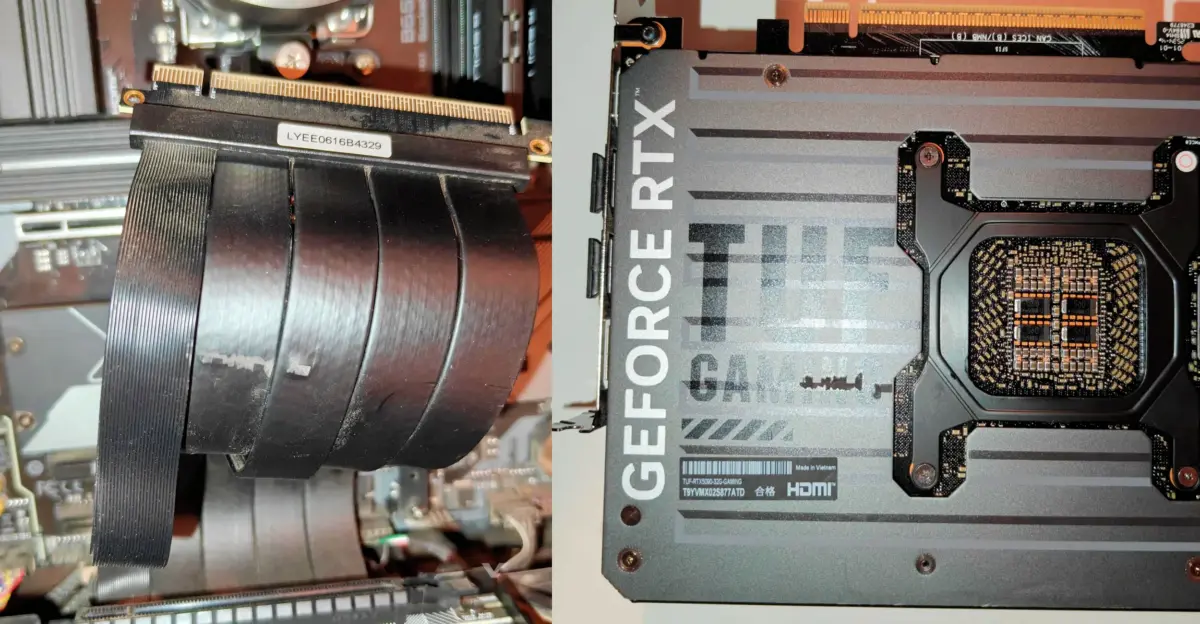
A high-end graphics card owner discovered that direct contact between a 575W GPU backplate and a PCIe riser cable can melt insulation, a risk that applies to anyone building a PC with a vertical mount. The incident involved an ASUS TUF GeForce RTX 5090, and while the graphics card itself remained undamaged, the thermal output of the card created a hazard for nearby components. This finding matters to builders because it highlights a specific thermal interaction that can destroy accessories even when the primary hardware functions correctly. Users who prioritize clean vertical installations should now account for the heat density of modern high-wattage cards when routing cables.
High-wattage GPU heat degrades cable insulation when placed in direct contact
The hardware at the center of this report is the NVIDIA GeForce RTX 5090, a new flagship GPU that draws significant power from the system. The specific model involved in the reported incident was the ASUS TUF GeForce RTX 5090, which features a substantial metal backplate designed for structural support and heat dissipation. The card occupies a standard PCIe x16 slot, which provides a baseline of 75W of power, but the card itself consumes up to 575W. This high power draw generates considerable thermal energy that the card must manage, often resulting in hot surfaces on the exterior of the unit.
The technical details of the failure point to a combination of high heat output and restricted airflow. A user reported that the insulation on a PCIe riser cable melted where it touched the backplate of the GPU in a vertical mount configuration. The card itself did not suffer electrical damage, but the cable insulation degraded due to the direct contact. The backplate of the RTX 5090 reaches temperatures high enough to affect certain cable materials when airflow is blocked. Standard PCIe riser cables are not typically designed to withstand prolonged exposure to the heat levels generated by the back of a 575W graphics card.
This scenario raises questions about the thermal management of vertical GPU mounts when used with high-power components. The incident suggests that the specific insulation material of the riser cable may not be rated for the temperatures found on the GPU backplate. Some analysis indicates that backplates usually do not reach temperatures high enough to melt proper cable insulation during normal use, implying that the specific cable quality or lack of airflow was a contributing factor. Builders using vertical mounts should ensure that cables do not rest directly against the GPU backplate to prevent similar thermal damage.
We looked at LEVEL∞ RTX 5090 Laptop Launches at Around $4,120 earlier while tracking NVIDIA launches. The reported incident confirms that the thermal output of the RTX 5090 is a practical consideration for desktop builders using vertical mounts. The GPU itself remains functional, but the surrounding components require careful placement to avoid heat-related damage. Users should prioritize airflow and cable clearance when installing this card to protect their PCIe riser cables and maintain system stability.

Discussion
0 comments
Log in to join the thread with a thoughtful take, question, or correction.