
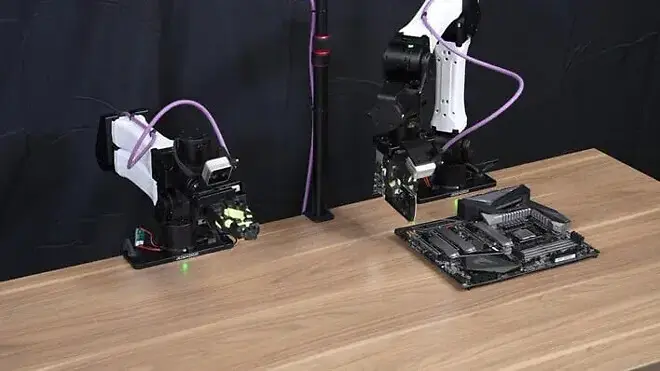
NVIDIA, Carnegie Mellon University, and UC Berkeley have released Enpire, a framework that trains physical AI agents without human supervision. The system relies on a closed-loop feedback mechanism that cycles through environment interaction, policy improvement, rollout, and evolution modules. This autonomous approach removes the need for manual human intervention during the training process.
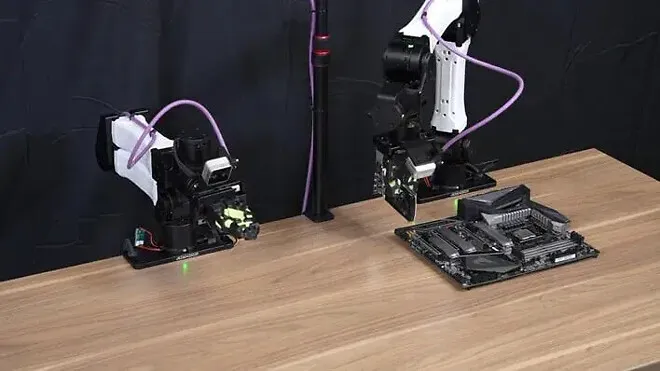
Autonomous framework enables robots to handle complex hardware assembly tasks
The research team tested the Enpire framework using robots equipped with coding agents based on GPT 5.5, Claude Code Opus 4.7, and Kimi K2.6. These models enabled the robots to perform complex physical tasks with a high degree of precision. The setup demonstrates how large language models can drive hardware manipulation in real-world scenarios.
Robots using the Enpire framework achieved a 99% success rate on the pass@8 metric for intricate tasks. One specific test involved installing graphics cards into PCIe slots without any human guidance. The system successfully navigated the physical constraints of the hardware to complete the installation reliably.
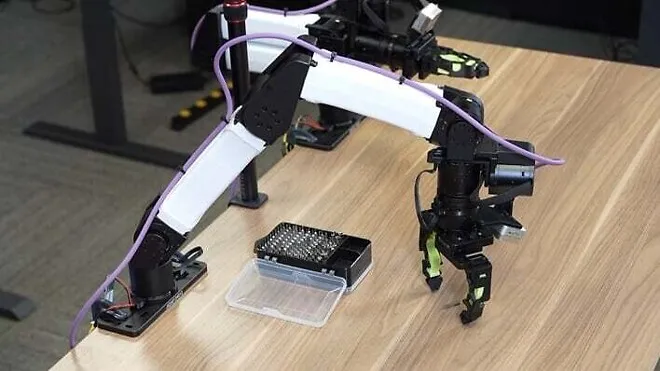
Scaling the operation from one agent to eight agents reduced the task completion time from nearly five hours to approximately two hours. This speed improvement came with a significant increase in token usage across the system. The trade-off highlights the computational cost of parallelizing autonomous robotic tasks.



Discussion
0 comments
Log in to join the thread with a thoughtful take, question, or correction.