
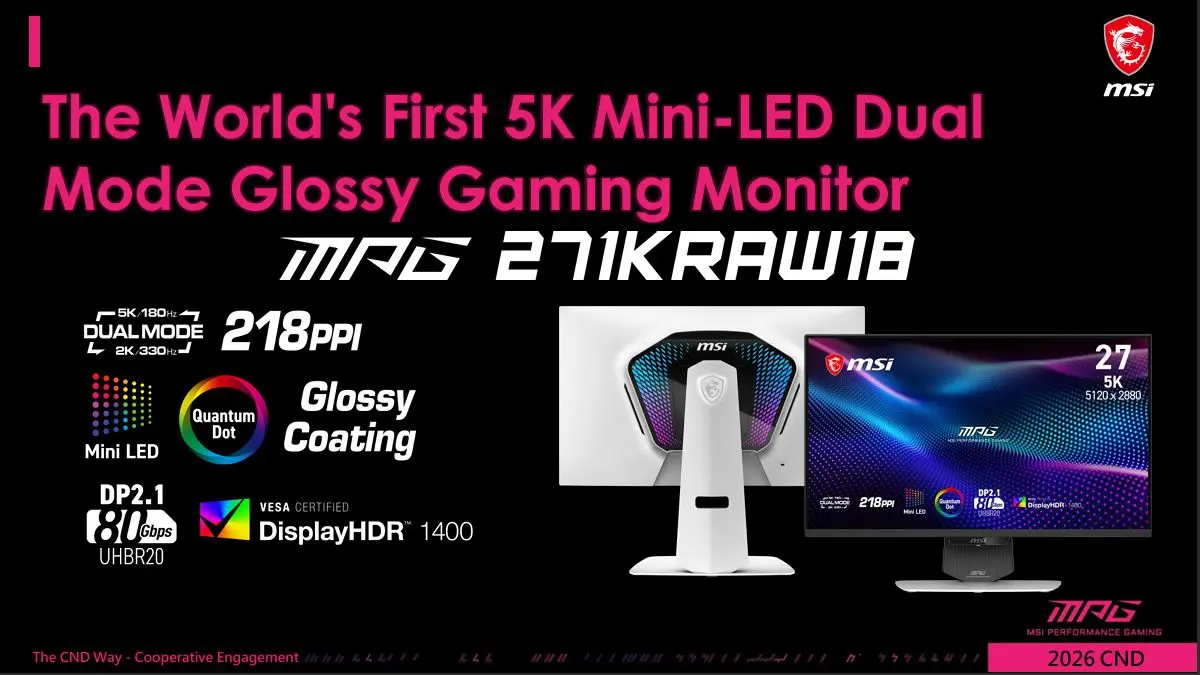
MSI and Gigabyte have introduced two new 27-inch gaming monitors that target users seeking high resolution without sacrificing screen size. Both models deliver a native 5,120 by 2,880 pixel count on compact panels designed for close viewing distances. The displays use Mini-LED backlighting with 2,304 dimming zones to manage contrast and reduce visual artifacts like blooming. This approach allows the monitors to achieve high peak brightness while maintaining deep blacks in dark scenes.
New monitors from MSI and Gigabyte feature 5,120 by 2,880 resolution with Mini-LED backlighting for high contrast gaming.
The MSI MPG 271KRAW18 and Gigabyte Aorus FM275K16P share a common panel foundation built by BOE. Each monitor utilizes a Rapid IPS LCD layer paired with a glossy coating and a quantum-dot film to expand color range. The panel covers 98 percent of the DCI-P3 color space with an average Delta-E value under two for accurate color reproduction. Gigabyte also includes a dedicated hardware chip to upscale lower resolutions, whereas MSI relies on AI-based software processing for similar tasks.
Spec comparison
| Spec | MSI MPG 271KRAW18 | Gigabyte Aorus FM275K16P |
|---|---|---|
| Resolution | 5,120 x 2,880 (5K) | 5,120 x 2,880 (5K) |
| Panel Type | Rapid IPS with glossy coating and quantum-dot layer | Rapid IPS with glossy coating and quantum-dot layer |
| Backlight | Mini-LED, 2,304 dimming zones (approx. 10,000 LEDs), 0-OD design | Mini-LED, 2,304 dimming zones (approx. 10,000 LEDs), 0-OD design |
| HDR Certification | DisplayHDR 1400 | DisplayHDR 1000 |
| Peak Brightness | 1,400 nits | 1,250 nits |
MSI sets its native refresh rate at 180 Hz and allows users to overclock the display to 330 Hz when switching to 1440p resolution. Gigabyte offers more flexible timing options with a default 165 Hz mode, an overclocked 180 Hz mode, and support for up to 220 Hz at 4K or 330 Hz at 1440p. The MSI model holds DisplayHDR 1400 certification and reaches 1,400 nits of peak brightness in HDR content. Gigabyte achieves slightly lower performance with DisplayHDR 1000 certification and a maximum output of 1,250 nits.
Connectivity details diverge between the two brands despite their similar physical layouts. MSI equips its monitor with a full UHBR20 DisplayPort 2.1 connection and provides 98 watts of power delivery through its USB-C port. Gigabyte includes HDMI 2.1 support with eARC audio return but limits USB-C power output to just 15 watts. Both units retain standard ports including dual USB-A connections, a USB-B upstream interface, and a 3.5mm headphone jack for local audio.
Pricing and release schedules differ significantly across the two offerings. Gigabyte lists its Aorus FM275K16P at $999 USD with a planned launch window in the fourth quarter of 2026. MSI states that its MPG 271KRAW18 will arrive next year in January, though the specific calendar year remains undefined relative to current reporting timelines.
These displays aim to solve the pixel density issues common on smaller high-resolution screens by packing nearly five million pixels into a 27-inch frame. The zero optical distance design removes physical gaps between the backlight and LCD layer to minimize light bleed around bright objects. Early benchmarks suggest the hardware upscaling on Gigabyte performs well, but independent testing is required to verify actual image quality improvements.

Discussion
0 comments
Log in to join the thread with a thoughtful take, question, or correction.