
Linux 7.3 will arrive in the second half of 2024 with a critical patch that unlocks the full potential of high-end storage hardware. Server administrators and cloud engineers who rely on PCIe Gen5 NVMe SSDs will see immediate performance gains that were previously blocked by software inefficiencies. This update addresses a specific bottleneck that caused significant waste in small file read operations, ensuring that expensive hardware delivers the speed it promises.

Kernel update targets IOmap overhead to unlock full SSD speed
The improvement stems from a targeted fix to the Linux IOmap framework, which manages input and output operations for direct data paths. ByteDance engineer Chang Fengnan identified that the previous implementation created redundant overhead during memory allocation and state machine scheduling. The kernel team has now introduced a lightweight direct-write I/O path that bypasses these unnecessary steps for small I/O requests.
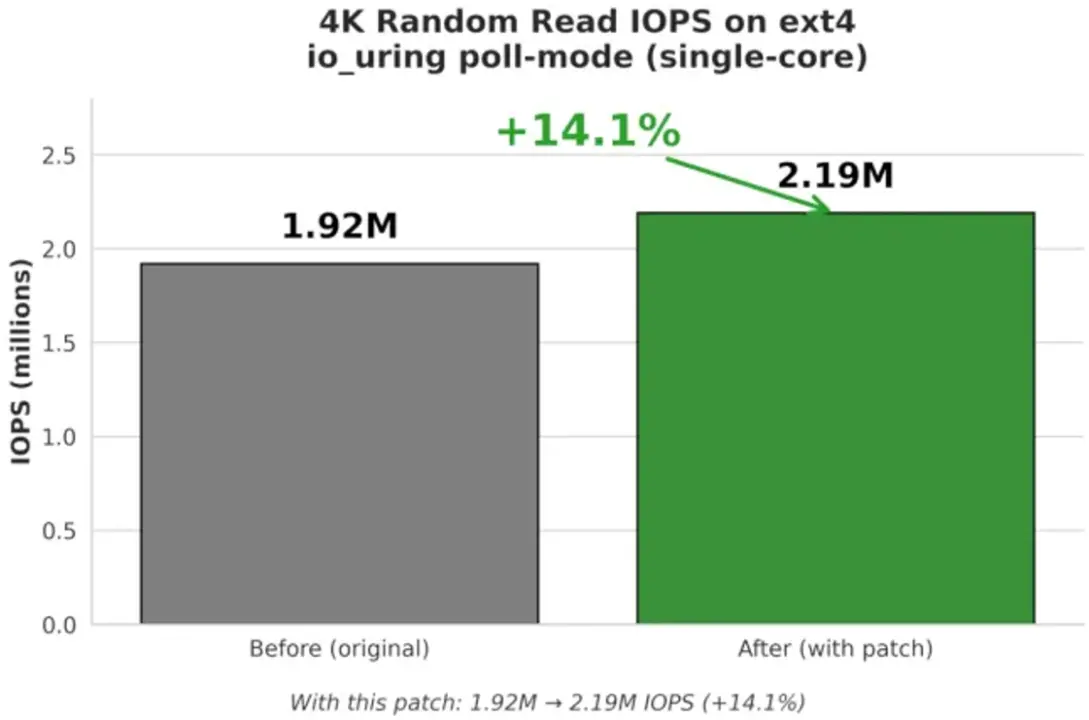
Benchmarks on devices equipped with PCIe Gen5 NVMe solid-state drives confirm the effectiveness of this change. The 4K random read IOPS score jumps from 1.92 million to 2.19 million, representing a substantial increase in raw throughput. This optimization specifically targets the small file read and write patterns that often choke high-performance storage controllers under load.
The patch maintains compatibility with the two dominant server filesystems, EXT4 and XFS, ensuring broad adoption without requiring filesystem migration. IO_uring tests also reveal a 10% performance boost in high queue-depth scenarios, which benefits database and cloud storage workloads. These combined improvements eliminate the performance waste that previously limited the utility of top-tier storage hardware on Linux systems.
Linux 7.3 is scheduled for release in the second half of 2024, bringing these storage optimizations to global users. The update resolves the underlying inefficiencies in the IOmap framework, allowing systems to fully utilize the capabilities of modern PCIe Gen5 NVMe SSDs. Administrators can expect smoother performance for small file operations and improved throughput in high-concurrency environments once the version goes live.



Discussion
0 comments
Log in to join the thread with a thoughtful take, question, or correction.