
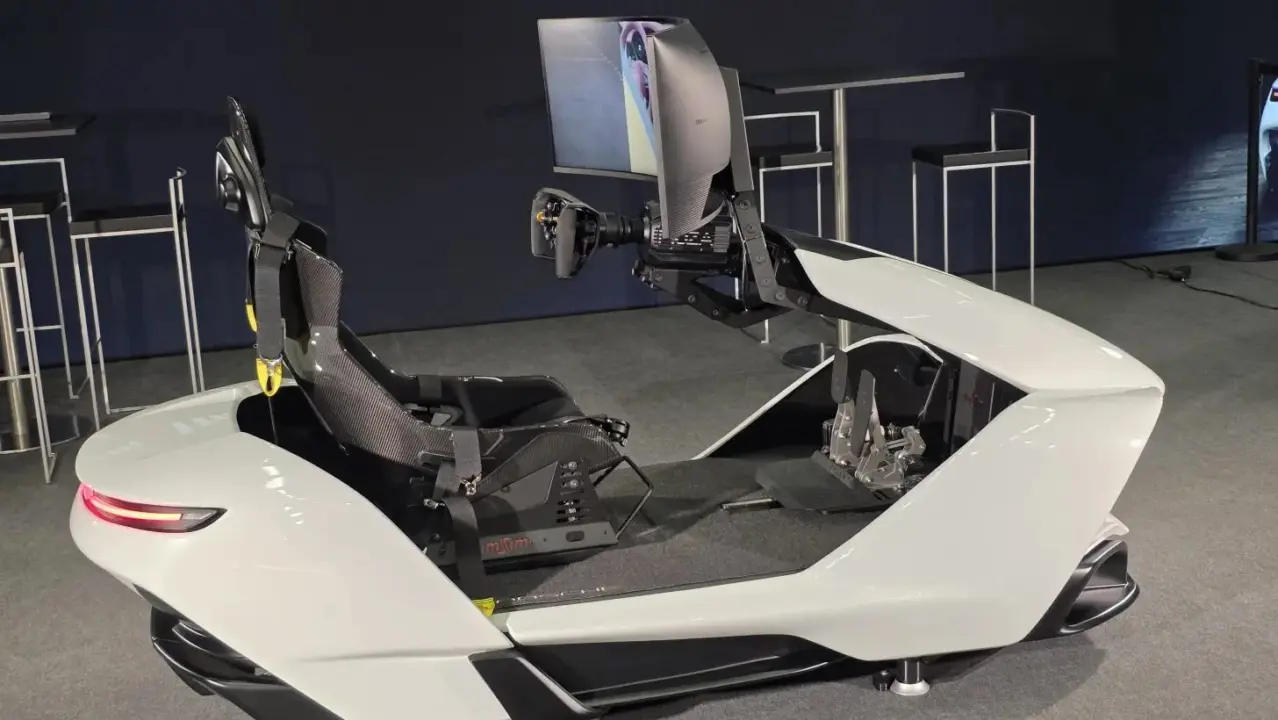
ImSim and Porsche have teamed up to release the Raceborn, which is a racing simulator. It's as expensive as a sports car. This isn't for the casual gamer.
The high-end racing rig features motion actuators and haptic feedback for professional training
This is for professionals and high end entertainment businesses. The goal is to simulate the feelings of driving fast and furious cars using advanced motion and haptic technology.
This simulator has a 57 inch ultra wide screen that takes over your vision. You sit in a carbon fiber racing seat connected to a motion system with 4 actuators. There's a MOZA direct drive wheelbase with 21Nm of torque to give you the feel of the steering wheel.
You have 4 ButtKicker transducers for haptic feedback as well as an active safety belt system. These together provide a sense of the forces you feel while racing. The entire experience gives you a full sensory stimulation for training or entertainment.
This simulator is about 70,000 EUR. That translates to about $78,119. That's the same price range as a Porsche Macan S. That costs about 76,990 GBP. The price is up there due to the specialization of the equipment and the collaboration of the two brands.
This is a new level of racing simulation. The technology is moving towards more professional grade gear. The use of motion and haptics as well as the quality of the equipment.
This is a new era for immersive driving. You can buy the Raceborn at the global price listed.
That price tag is enough to make my head spin. I still remember when sim rigs cost less than a used car. This is absurd luxury for a driving game.
tbh i thought the 57 inch screen was the main selling point but the active safety belt is the real flex here 🤔
Does the MOZA 21Nm wheelbase actually provide enough torque to simulate the weight transfer on a GT3 car or is it just vibing with the motion platform
21Nm is solid for direct drive but the real test is the latency between the motion actuators and the steering input. If the synchronization is off the haptics will just feel like noise rather than force feedback.
I am not sure this is worth it for entertainment businesses. The maintenance costs for carbon fiber seats and four ButtKicker transducers will eat the profit margins fast.
Seven thousand pounds for a Macan S and 78k for a chair
How does the active safety belt interface with the software to trigger the haptic feedback without causing false positives during normal cornering forces
It likely uses a low level driver that bypasses the OS input stack. This reduces latency to the millisecond range which is critical for belt triggers. You need near zero lag to make the belt feel like it is tightening correctly.
I can barely afford a GPU for my PC let alone a whole room of hardware 💀
The article mentions professional training but does not specify if the motion system supports Linux. Most high end peripherals rely on Windows specific kernel drivers.
ngl this feels like overkill for sim racing. The motion platform does most of the work so the expensive wheel base might be redundant