

Google released the Gemma Translator, a local offline translation device that lets users communicate without internet access. This matters because it removes the need for cloud connectivity, making real-time translation possible in areas with poor or no network coverage. The device operates entirely offline, ensuring privacy and reliability for travelers or field workers who cannot rely on stable connections.
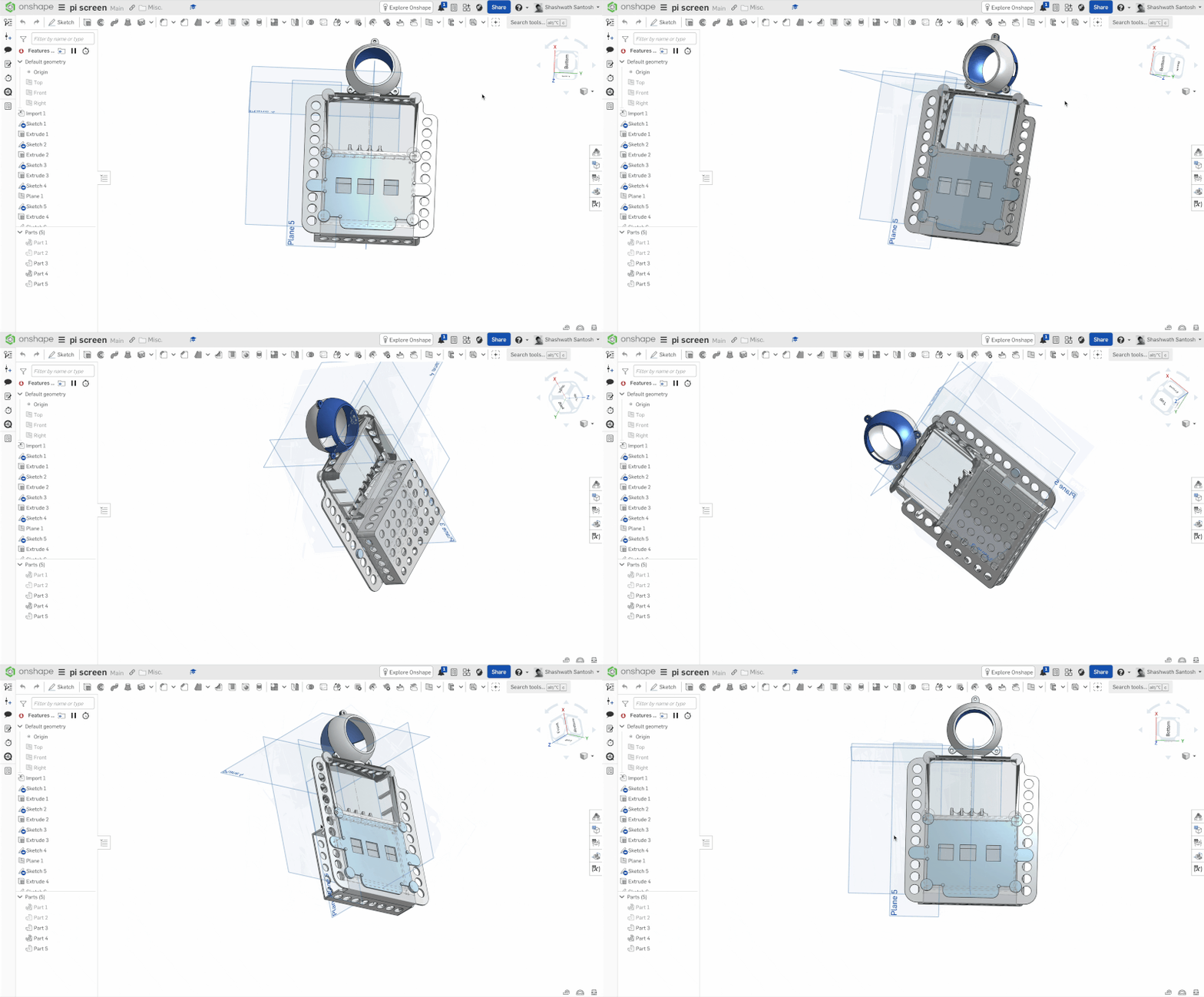
Google releases offline translation device using Gemma 4 E2B AI model
The hardware platform is the Raspberry Pi 5 single-board computer, chosen for its balance of processing power and energy efficiency. Google paired this accessible edge device with the Gemma 4 E2B open-source generative AI model, which contains 5.1 billion total parameters. This combination allows the system to run complex language tasks on compact, low-cost hardware without requiring massive server infrastructure.
Specifications
- AI Model: Gemma 4 E2B
- Total Parameters: 5.1B
- Active Parameters: 2.3B
- Hardware Platform: Raspberry Pi 5
- Inference Framework: LiteRT-LM
Translation inference is handled by Google's LiteRT-LM framework, which is designed specifically for edge devices. The model uses a mixture-of-experts architecture with 2.3 billion active parameters, optimizing speed and resource usage during translation tasks. This technical setup ensures that the device can process language data efficiently while maintaining low power consumption on the Raspberry Pi 5.
Speech-to-text and text-to-speech functions are processed locally using Moonshine AI, another Google-developed tool. This local audio processing eliminates the latency and data costs associated with cloud-based voice assistants. Users can speak directly into the device and receive immediate audio feedback, creating a seamless translation experience without any external data transmission.



Discussion
0 comments
Log in to join the thread with a thoughtful take, question, or correction.