
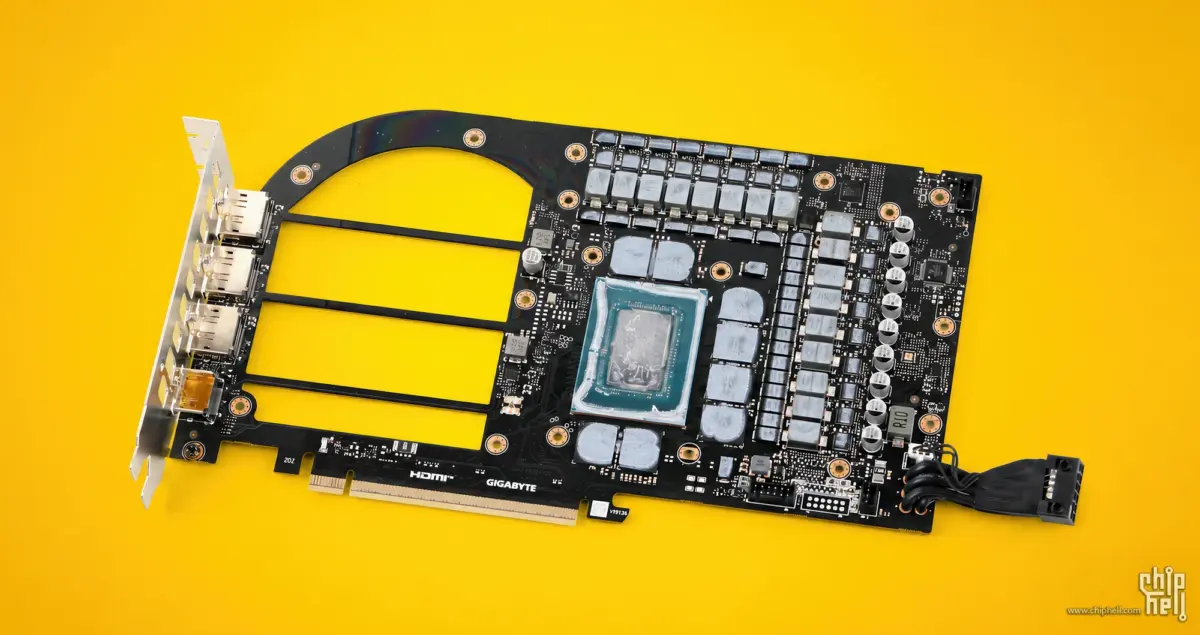
Gigabyte redesigned its AORUS GeForce RTX 5080 Infinity graphics card with a custom single printed circuit board that features a large central cutout. This structural change enables a Double Flow Through cooling system that pushes air through the card rather than just across its surface. Buyers who prioritize airflow efficiency and unique thermal architectures should take note of this departure from standard full-length GPU designs. The teardown reveals how Gigabyte prioritized airflow dynamics over traditional board continuity.
Custom single PCB design enables Double Flow Through cooling system
The card operates on a platform similar to NVIDIA Founders Edition cards by allowing air to pass through both sides of the graphics processor. Gigabyte implemented this layout by removing material from the center of the PCB to create a wide opening for the cooling fans. This design choice distinguishes the Infinity model from conventional high-end GPUs that rely on dense fin stacks and solid board structures. The approach aims to reduce thermal resistance by utilizing the space around the card more effectively.
- PCB Design: Single PCB with large central cutout for Double Flow Through cooling
- Cooling Architecture: Pass-through airflow design similar to NVIDIA Founders Edition but with a larger opening
- Power Connector: Recessed workstation-style 16-pin connector with built-in extension
- Power Rail Layout: MSVDD rail extended to the right side of the GPU package
Technical details show that the MSVDD power rail extends to the right side of the GPU package, which differs from the NVIDIA Founders Edition placement on the left. The card also includes a recessed workstation-style 16-pin power connector with a built-in extension that carries six conductors. A metal block secures this connector to the board, but teardown observations indicate the block provides mechanical reinforcement rather than thermal cooling. The absence of thermal interface material between the connector and the block confirms its structural role.
We have been tracking AORUS GeForce RTX 5080 Infinity closely and noted earlier coverage on GIGABYTE AORUS INFINITY Motherboard and RTX availability. The unique PCB layout may make the exposed board more vulnerable to bending when removed from its metal support structure. This potential structural weakness is a trade-off for the aggressive cooling design that defines the Infinity series. The card remains a specialized hardware option for users willing to manage its specific physical requirements.
Discussion
0 comments
Log in to join the thread with a thoughtful take, question, or correction.