
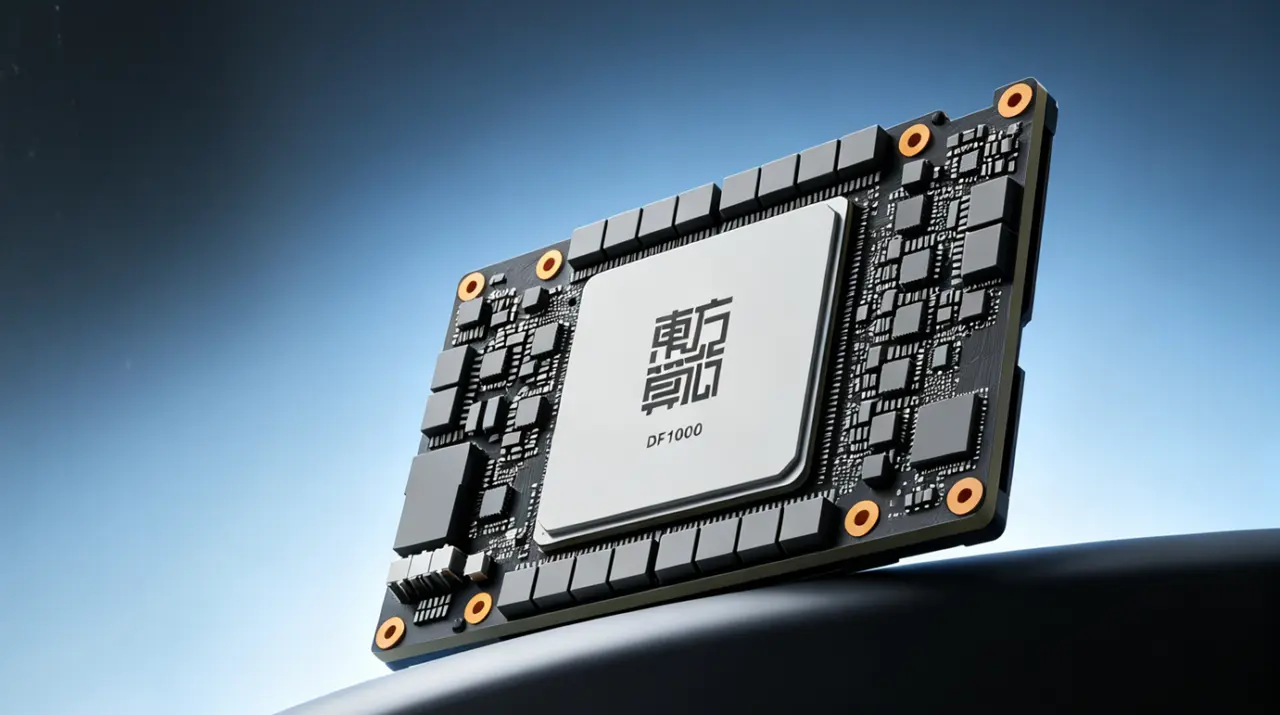
Dongfang Suanxin has released the DF1000, a new AI accelerator that challenges the industry's reliance on advanced semiconductor nodes. This launch matters because it demonstrates that high-performance computing is possible using mature manufacturing processes. Buyers in regions with supply chain restrictions can now evaluate a domestically produced alternative to leading global GPUs.
New hardware uses mature 14nm process and 3D stacking for high bandwidth
The DF1000 is built on a 14nm process node, which is considered a mature technology in the semiconductor industry. It achieves 520 TFLOPS of BF16 compute performance without requiring the most cutting-edge overseas fabrication methods. This approach allows for a fully domestic supply chain from design to manufacturing.
DF1000 Specifications
- Process Node: 14nm
- BF16 Compute Performance: 520 TFLOPS
- Memory Bandwidth: 6.4 TB/s
- Interconnect Bandwidth: 900 GB/s
- Architecture: 3D Hybrid Bonding, Near-Memory Computing
The chip utilizes a 3D hybrid bonding design to stack compute and storage resources with high density. This architecture supports near-memory computing, which reduces the distance data must travel within the chip. The single card delivers 6.4 TB/s of memory bandwidth to support intensive workloads.
For multi-card configurations, the DF1000 provides 900 GB/s of interconnect bandwidth for Scale-up operations. This technology originates from the Institute of Microelectronics at Tsinghua University. The company has outlined a roadmap that includes the DF2000 in the fourth quarter of 2026 and the DF3000 in the fourth quarter of 2027.
The DF1000 represents the world's first software-defined near-memory computing 3D chip. It offers a specific set of performance metrics for AI and hardware applications. The product is currently available as a new entry in the Chinese semiconductor market.


Discussion
0 comments
Log in to join the thread with a thoughtful take, question, or correction.