
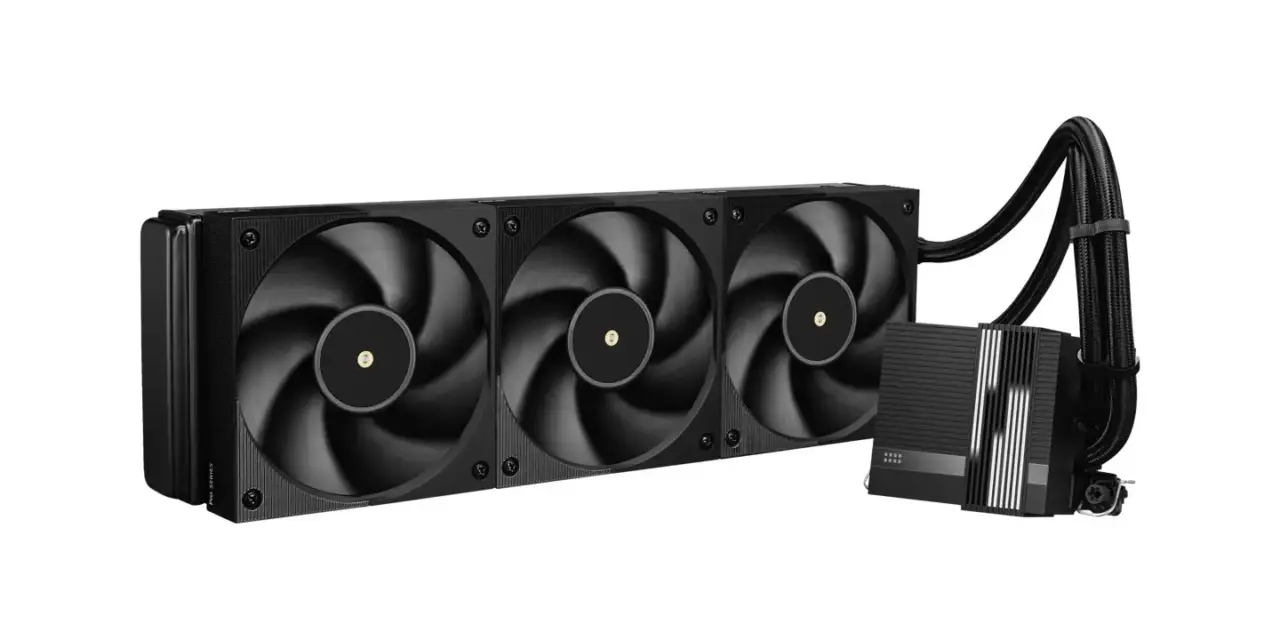
ASUS extends their range of liquid coolers to include a dedicated one for Intel's latest workstation CPUs. The Pro WS LC 360-4710 is a cooler designed to serve system builders using LGA 4667/4710 socketed Intel Xeon CPUs. With this, ASUS is offering dedicated liquid cooling solution to these niche workstation platforms. For users working with these architectural platforms, there is now a factory-backed cooling solution.
ASUS introduces a dedicated AIO liquid cooler for Intel LGA 4667 and LGA 4710 Xeon workstation processors
The cooling solution uses an Asetek pump-based design for heat transfer. The pump motor operates at a maximum speed of 3450 RPM. This is connected to the CPU water block using 465mm sleeved rubber tubes.
Specifications
- Socket Compatibility: Intel LGA 4667, LGA 4710
- Pump Speed: 3,450 RPM
- Tube Length: 465mm
- Radiator Thickness: 38mm
- Fan Airflow: 99.66 CFM
The water block features ARGB LED lights for some customization. It offers user with real-time system temp data monitoring as well.
The heat is dissipated using an aluminum radiator that's 38mm thick. It utilizes 120mm fans that provide the airflow for cooling the radiator fins. They're rated for a max airflow of 99.66 CFM.
They also produce 6.34 mmAq static pressure. For noise levels, the maximum operational noise is rated at 39.1 dB(A).
ASUS backs this particular workstation cooler with a 6-year warranty. The Pro WS LC 360-4710 was registered with ASUS' official website on November 12. We had previously covered the consumer-oriented ASUS LC 360 ARGB AIO cooler.
This one is specifically made for Intel Xeon workstation CPUs. Not for consumer desktop CPUs. The new Pro WS model is solely focused on being a workstation-oriented, long-lived cooler.
The cooler is designed to work with Intel LGA 4667 and LGA 4710 socket for Intel Xeon CPUs. The high speed pump and the thick radiator addresses the thermal needs of Xeon CPUs. For users using LGA 4667/LGA 4710 boards, this AIO can now be installed right away. The 6-year warranty ensures long-term reliability in the professional workstation setting.


Comments (0)