
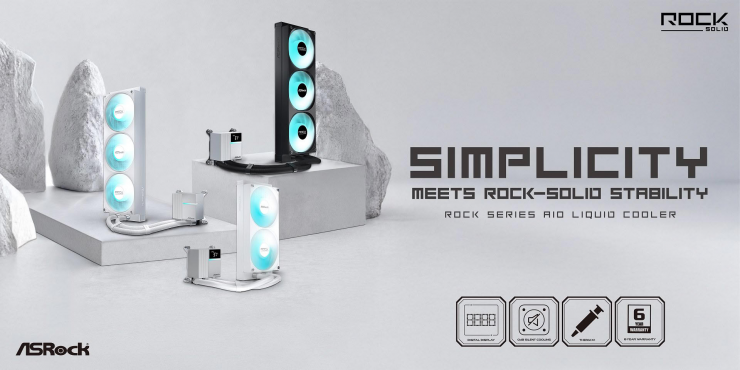
ASRock has introduced the Rock series, a new line of all-in-one liquid coolers designed to simplify PC building. The lineup offers eight models across two radiator sizes, giving builders a straightforward choice for thermal management. This launch provides a clear, no-nonsense option for users who prioritize clean aesthetics and reliable cooling without complex setup procedures.
Eight models with digital and ARGB variants target clean PC builds
The series splits into two distinct visual paths: a Digital version featuring a 1.05-inch LCD screen and a standard ARGB model. Both variants share the same underlying hardware architecture, ensuring consistent performance regardless of the chosen aesthetic. ASRock describes this approach as 'Solid Starts Simple,' aiming for a minimalist design that blends naturally into various PC builds.
Specifications
- Radiator Sizes: 360mm, 240mm
- Color Options: Black, White
- Display (Digital Version): 1.05-inch LCD
- Pump Type: 3-phase 6-slot high-performance pump
- Tube Material: IIR + EPDM

At the core of every Rock cooler is a 3-phase, 6-slot high-performance pump designed to move coolant efficiently. The system uses IIR and EPDM materials for the tubing to prevent degradation and ensure longevity. Each unit comes pre-installed with fans and is pre-applied with ASRock Therm-X1 thermal paste to reduce initial installation friction.
The Digital variant allows users to monitor CPU temperatures in real time through the integrated LCD display. Both the 360mm and 240mm radiator options are available in black and white colorways to match different chassis themes. The entire series is backed by a six-year warranty, signaling confidence in the pump and tube durability.
ASRock positions the Rock series as a practical entry point for builders seeking reliable cooling with a clean look. The inclusion of pre-applied thermal paste and standardized fittings aims to streamline the assembly process. These coolers offer a balanced solution for users who want effective heat dissipation without unnecessary complexity.
Discussion
0 comments
Log in to join the thread with a thoughtful take, question, or correction.